

Open enrollment season, and an HR coordinator at a mid-size employer just finished processing a new hire's benefits election. The employee, we'll call him John Doe, picked a PPO plan and added his wife and two kids as dependents. On his end, that was a five-minute form. On the back end, that form now has to become a structured, HIPAA-compliant EDI 834 transaction, travel to a health insurance carrier, get parsed and validated without errors, and land as clean, queryable data in the carrier's enrollment system, all without anyone touching a line of code.
This is what that journey looks like inside Astera EDIConnect.
The 834 sits on a different track from claims transactions like 837 and 835 (link to Hasham's article), which run between providers and payers rather than employers and health plans.
It starts as four separate records, not one
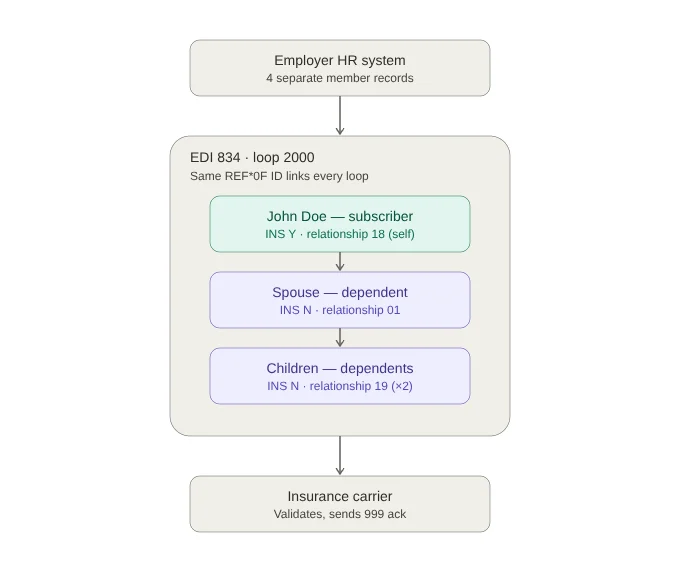
Before EDIConnect ever sees an X12 segment, the employer's HRIS or benefits admin platform has four related but distinct records: John Doe (the subscriber), his spouse, and his two children (the dependents). Each has its own demographic details (name, date of birth, SSN, relationship to subscriber), but they all share one enrollment: same plan, same effective date, same group number.
That distinction between subscriber and dependent matters more than it sounds like it should, because it's how EDI organizes structured data for exchange between systems in the first place, and the entire 834 spec is built around it.
Building the transaction: subscriber and dependent live in different loops
Inside EDIConnect, the outbound EDI 834 is built using a drag-and-drop mapping canvas rather than hand-coded X12. But under the hood, the transaction still has to follow the 834's hierarchical structure, and that's where subscriber and dependent data physically separate:
INS segment:
Opens each member's loop and flags whether that person is the subscriber (INS01 = "Y") or a dependent (INS01 = "N"), the individual relationship code (INS02: 18 for self, 01 for spouse, 19 for child), and the maintenance type (add, change, or termination).
REF segment:
Carries the subscriber identifier (REF*0F). The same subscriber ID repeats on the subscriber's loop and on every dependent's loop underneath it, which is how the carrier ties the kids and spouse back to John Doe once the file lands. The INS02 relationship code is what tells the carrier how each person relates to that subscriber.
DMG segment:
Date of birth and gender. Beyond identity, this is what a carrier's system checks a dependent's age against, for plan-specific eligibility rules like a child aging out of coverage at 26.
DTP segment:
The effective date. Same date across all four records in this case, but EDIConnect allows different effective dates per member if, say, a dependent is added mid-year.
NM1 loop:
Name and identifying info, repeated once per person.
HD loop:
Health coverage detail, which can differ per person if the dependents are on a different coverage tier than the subscriber.
EDIConnect maps each of John Doe's four HR records into its own member loop, in the correct hierarchical order (subscriber first, dependents nested under it), without the mapping developer needing to memorize X12 loop and segment IDs. The canvas shows the target 834 schema visually, and fields get connected from the source system to the right segment.
See EDIConnect Build and Validate an 834 in Minutes
Watch subscriber and dependent data get mapped, validated, and transmitted to a carrier, live and in a real workflow.
The trade partner profile decides how strict this gets
Every insurance carrier John Doe's employer works with has its own trade partner profile set up in EDIConnect: its own inbound/outbound maps, its own accepted separators, its own validation rules layered on top of the standard ANSI X12 5010 requirements. One carrier might reject a dependent's INS02 relationship code if it doesn't match its accepted list; another might flag a dependent whose DMG birth date puts them past that plan's age-out threshold for coverage.
This is the step where a lot of enrollment data actually breaks in other systems, but doesn't need to here. EDIConnect validates the transaction against both the standard 834 spec and that carrier's custom rules before the file goes out, not after it bounces back. If a dependent's relationship code doesn't match an expected value, or a required REF qualifier is missing, EDIConnect flags it at build time. John Doe's file doesn't leave the building until it's clean, the same pre-submission validation approach that raised one health plan's EDI approval rate to 98% (link to Laiba's article).
Transmission and the 999 handshake
Once validated, EDIConnect transmits the 834 directly to the carrier over AS2, SFTP, or API: no VAN, no middleman. The carrier's system parses the file and, per the EDI spec, sends back a 999 Implementation Acknowledgment confirming one of three outcomes: accepted, rejected, or accepted with errors.
That acknowledgment isn't a side note: it's the only confirmation the employer gets that John Doe's family is actually enrolled. A 999 doesn't just say accepted or rejected: its IK3 and IK4 segments point to the exact segment and element that failed, down to loop level. EDIConnect automates the tracking of inbound acknowledgments against the transactions they respond to, so if the carrier rejects the file over one bad dependent loop, the error traces back to that specific segment rather than leaving the HR team to guess which of the four member records caused it.
What happens after the handshake
Assuming clean acceptance, the enrollment data doesn't just sit as a processed file. It flows into EDIConnect's ETL layer, where it can be transformed and loaded into whatever backend the carrier or employer uses: a database, a data warehouse, or another downstream system like Centerprise AI. Subscriber and dependent records that were separate rows in an HR system, then separate loops in an X12 file, end up as related, queryable records again on the other side, with the subscriber-dependent relationship intact the whole way through.
Why the loop structure is the whole point
It would be easy to think of an 834 as just "enrollment data in a weird format." But the reason the transaction set is built around nested subscriber and dependent loops, rather than one flat record per household, is that it has to represent real relationships: dependents can be added, dropped, or changed independently of the subscriber; a subscriber's coverage can change without touching the dependents; a divorce or a birth changes one loop without requiring the whole household to be resubmitted.
EDIConnect is built around that same logic: partner profiles, validation, and mapping all operate at the loop and segment level because that's where the actual business rules live. Getting subscriber and dependent data right isn't a formatting detail. It's the difference between John Doe's family actually being covered on day one, and a rejected file sitting in a queue while he wonders why his kid's pediatrician visit didn't go through.
Automating 834 benefit enrollment. Astera EDIConnect builds, validates, and transmits EDI 834 transactions with subscriber and dependent data mapped to the correct loops automatically, in a no-code interface, the same AI-powered approach Astera applies to 834 documents and PDFs alike. Validation runs against both the X12 implementation guide and each carrier's partner-specific rules before a file goes out, and EDIConnect tracks inbound 999 acknowledgments against the transactions they respond to, so rejections trace back to the specific segment that caused them.
See This Play Out for a Real Health Plan
Chorus Community Health Plans automated their EDI error correction with EDIConnect and raised their state approval rate to 98%, cutting processing from three hours to five minutes per file.