

What is data centralization?
Data centralization is the process of consolidating data from multiple sources into a single, central location, usually a database, a cloud data warehouse, or a data lake. Centralizing data makes it more accessible and secure and helps improve decision-making.
Unlike a general concept of data management, data centralization focuses on creating a single version of truth for an organization’s information and providing a complete view of its operations. Examples of centralized data systems include traditional databases managed by a single server or data warehouses where data is consolidated for analysis.
Even though it requires careful planning to manage issues like scalability and potential single points of failure, data centralization is especially valuable for organizations seeking complete data control and consistent reporting.
For example, a company’s finance team might pull revenue from the CRM, costs from the ERP, and ad spend from marketing spreadsheets. Once all three feed one data warehouse, the monthly close no longer starts with a week of copying and reconciling files.
Why is data centralization important?
Data centralization is essential for organizations as it tackles a range of issues that hinder effective data management. When data is scattered across multiple systems, it creates obstacles that affect operational efficiency, data quality, and security. Consolidating data into a single repository addresses these challenges by providing a structured, reliable foundation for the entire organization.
The cost of getting this wrong is high. Gartner estimates that poor data quality costs organizations at least USD 12.9 million a year on average, and scattered, inconsistent data is a major cause.
Data centralization resolves the following problems:
Fragmented information: Disparate data sources often lead to inconsistencies and a lack of a single source of truth, making it difficult for teams to access reliable information.
Inefficient processes: Without centralized data, teams waste valuable time reconciling and validating data from multiple systems, slowing down decision-making and productivity.
Security vulnerabilities: Distributed data storage can increase the risk of breaches and compliance issues, as it becomes harder to enforce uniform security protocols across the organization.
Collaboration barriers: When data is siloed, departments struggle to share insights and collaborate effectively, which hampers innovation and coordinated efforts.
Regulatory and compliance challenges: Managing and auditing data across different platforms can complicate adherence to industry standards and legal requirements, exposing the organization to potential risks.
What is the difference between centralized data and distributed data?
A closely related concept to data centralization is distributed data.
The main difference between centralized data and distributed data lies in how each is stored. In a centralized data repository, all the data resides in a single location. In distributed systems, however, the data is spread out.
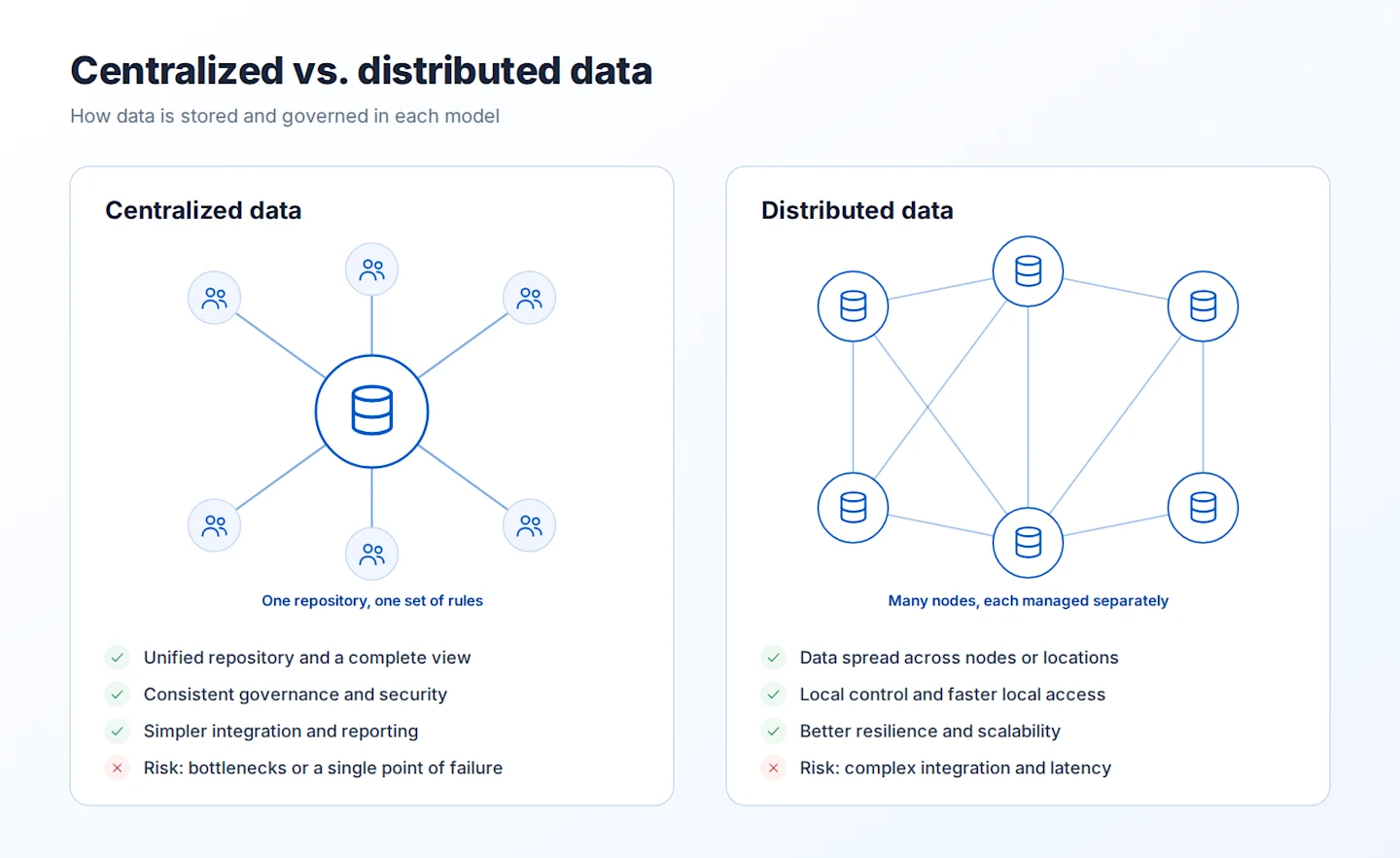
Characteristics of centralized data
When data is centralized, the following characteristics are typically observed:
Unified repository: All data is stored in a single database or data warehouse, providing a holistic view. Access to the data is typically controlled by a central authority or server.
Consistent governance: Data policies, security protocols, and quality controls are applied uniformly.
Simplified management: Data updates, backups, and maintenance tasks are streamlined due to a single point of administration.
Simplified data integration: Merging data from disparate sources is facilitated, leading to a more coherent dataset for analysis.
Potential bottlenecks: While consolidation simplifies oversight, it can also lead to performance issues if the central system is overloaded or experiences downtime.
Characteristics of distributed data
Distributed data is characterized by the following features:
Multiple storage locations: In a distributed data system, data is spread across multiple locations or nodes within a network.
Decentralized governance: There is no single central authority controlling all data; instead, data may be replicated or partitioned across different nodes. Each node typically manages its own subset of data independently, allowing local access and processing.
Enhanced scalability and resilience: Distributing data reduces the risk of a single point of failure and often supports better load balancing.
Complex integration: Aggregating data for organization-wide analytics is typically more challenging due to varying data structures and governance rules.
Latency considerations: Data access and synchronization across nodes can incur delays, affecting real-time decision-making.
Data centralization vs. data consolidation vs. data mesh
These terms are often used interchangeably, but they describe different things:
Term | What it means | Where data ends up |
Data centralization | The strategy of managing an organization’s data from one central platform, with shared governance | One central repository |
Data consolidation | The process of combining data from multiple sources, often the first step toward centralization | A combined dataset or repository |
Data mesh | A decentralized approach where each business domain owns and serves its own data as a product | Many domain-owned stores, with shared standards |
Learn more in our guides to enterprise data consolidation and data mesh.
The shift from data silos to data centralization
Siloed data refers to information that is segregated or compartmentalized within an organization and stored in separate databases or systems managed by individual departments or teams. In such cases, data isn’t easily accessible or shared across the organization.
Many organizations still operate with siloed data, limiting their ability to use analytics fully. Siloed data often results from a combination of factors, including disparate systems, inconsistent data formats, varying access permissions, or lack of integration, such as different departments using their own databases without connecting them to a unified system.
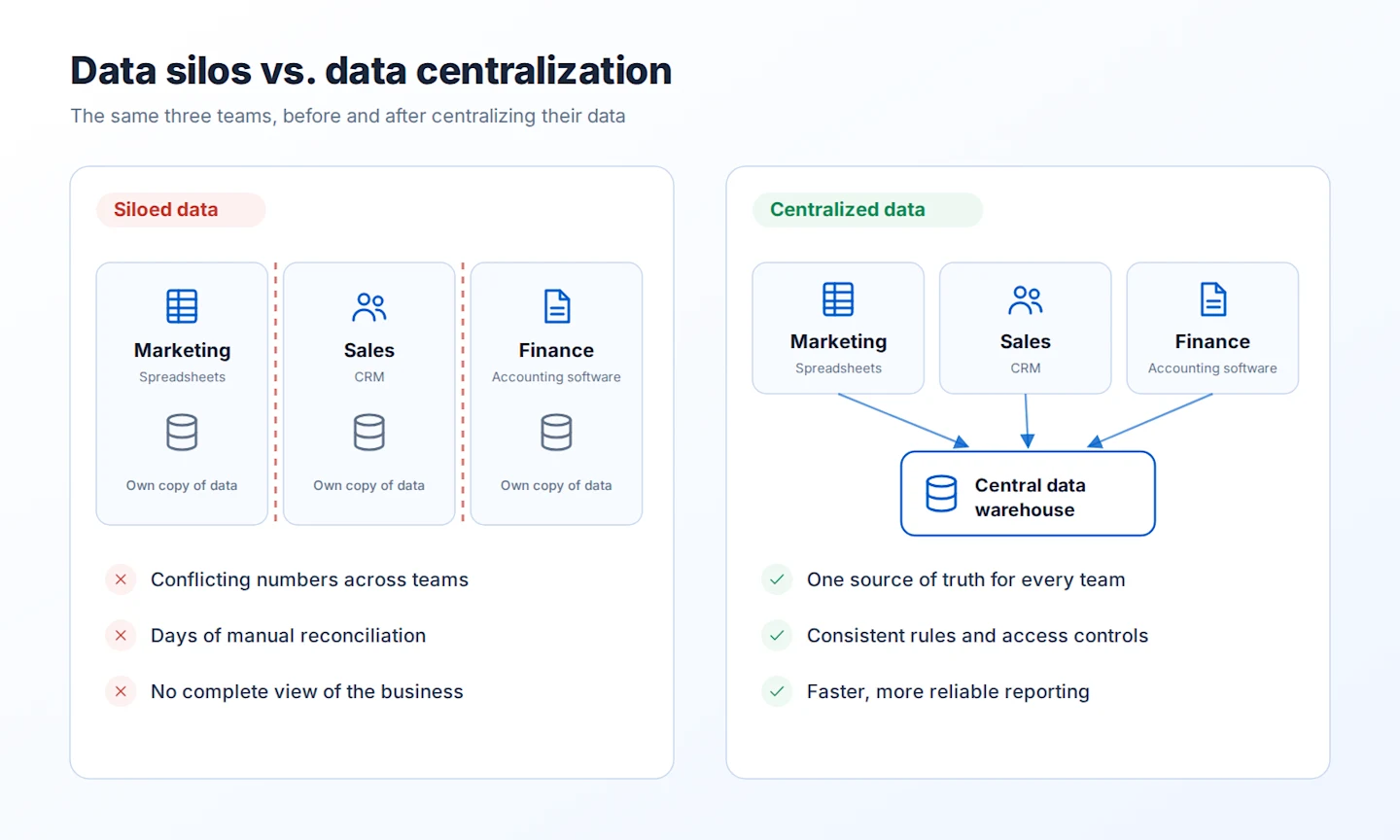
Siloed data challenges
Organizations face several hurdles due to decentralized data. These challenges include:
Legacy Systems: Outdated systems make it difficult to get the data you need into your data warehouse. Divergent data sources can lead to conflicting information, undermining accuracy and reliability.
Analysis Difficulties: Data in diverse and scattered sources requires extensive effort to consolidate and interpret, limiting data analytics capabilities.
Timely Decision-making Impediments: Data consolidation and reconciliation delays hinder prompt decision-making, which puts your company at a disadvantage to those able to process in real time.
Imagine a big organization with many departments, each responsible for its own financial data. The marketing department has its own set of spreadsheets tracking advertising expenses and campaign performance. The sales department has a CRM system that records customer transactions and revenue. The finance department has its own accounting software to manage financial statements.
The result? With data scattered across these silos, it’s challenging to gain a holistic view of the organization’s operations. The solution: Data centralization.
The Benefits of Data Centralization
Data centralization has several benefits to offer:
Improved Decision-Making: Data centralization enables everyone in the team to get a holistic view of the data they work on. For example, finance teams gain a comprehensive understanding of cash flow, revenue streams, and financial metrics. Having the most up-to-date information and a complete picture of all your data allows for more accurate forecasting and strategic decision-making.
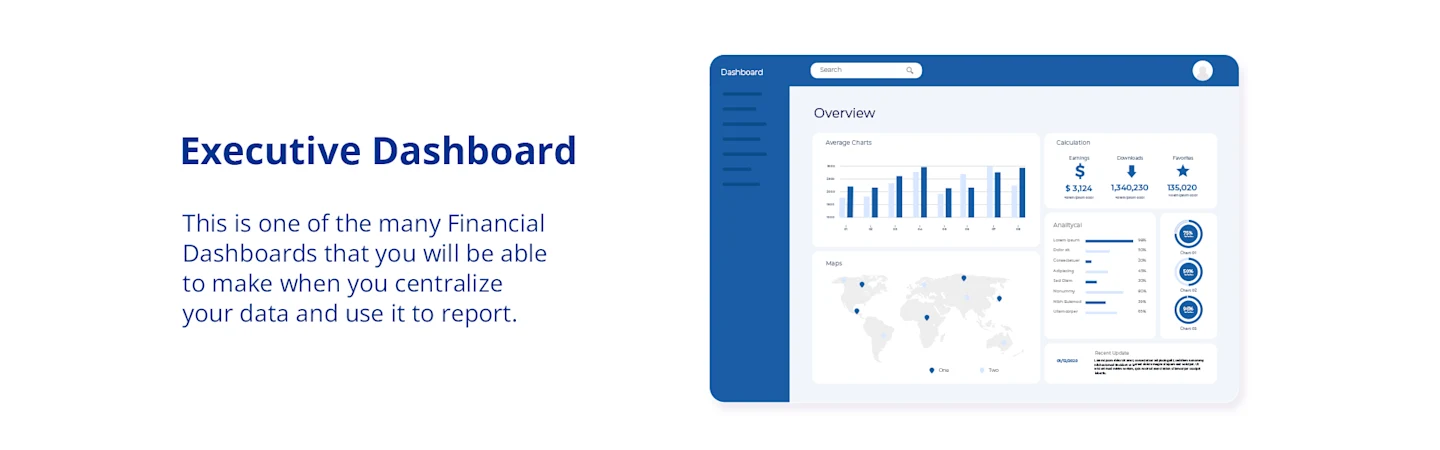
Enhanced efficiency: Data centralization streamlines business operations by eliminating manual data gathering from disparate sources. In finance, it can cut the time spent on monthly and quarterly reporting dramatically, freeing professionals to focus on strategic analysis.
Data integrity and compliance: Centralizing data leads to enhanced data integrity. It does so by maintaining data consistency and minimizing errors and discrepancies in the data sets. Additionally, complying with regulatory requirements is much easier when your data is organized and accessible.
Simplified data analysis and reporting: Data centralization lays the foundation for advanced analytics. With all relevant data in one place, organizations can use advanced analytics techniques, such as predictive modeling and ML, to uncover valuable insights. It’s easier to perform data analysis and generate meaningful reports with all the data in one place. Analysts can access a unified dataset without the need for complex data integration or reconciliation processes.
Scalability and Flexibility: As organizations grow, data centralization provides the scalability and flexibility needed to accommodate increasing data volumes and changing business requirements. The centralized repository can easily be expanded or modified to adapt to new data sources and analytical needs.
Enhanced Data Security: Centralizing data facilitates better security measures and access controls as a single, centralized repository is easier to manage. Organizations can implement centralized security policies, encryption standards, and authentication mechanisms to protect sensitive data from unauthorized access.
Improved Data Quality: Centralizing data improves its quality. During the centralization process, data is cleansed and standardized based on company standards. This creates a single repository of accurate, timely data that teams and management can trust for analysis, reducing the cost of errors in reporting and forecasting.
Increased Cost Savings: Centralizing data increases cost savings by reducing duplication of efforts as all data is present in a single location. This deduplication also minimizes the need for redundant infrastructure and optimizes data management processes.
How to implement data centralization: a step-by-step roadmap
Data centralization requires careful planning and execution. Let’s explore the key steps organizations should consider:
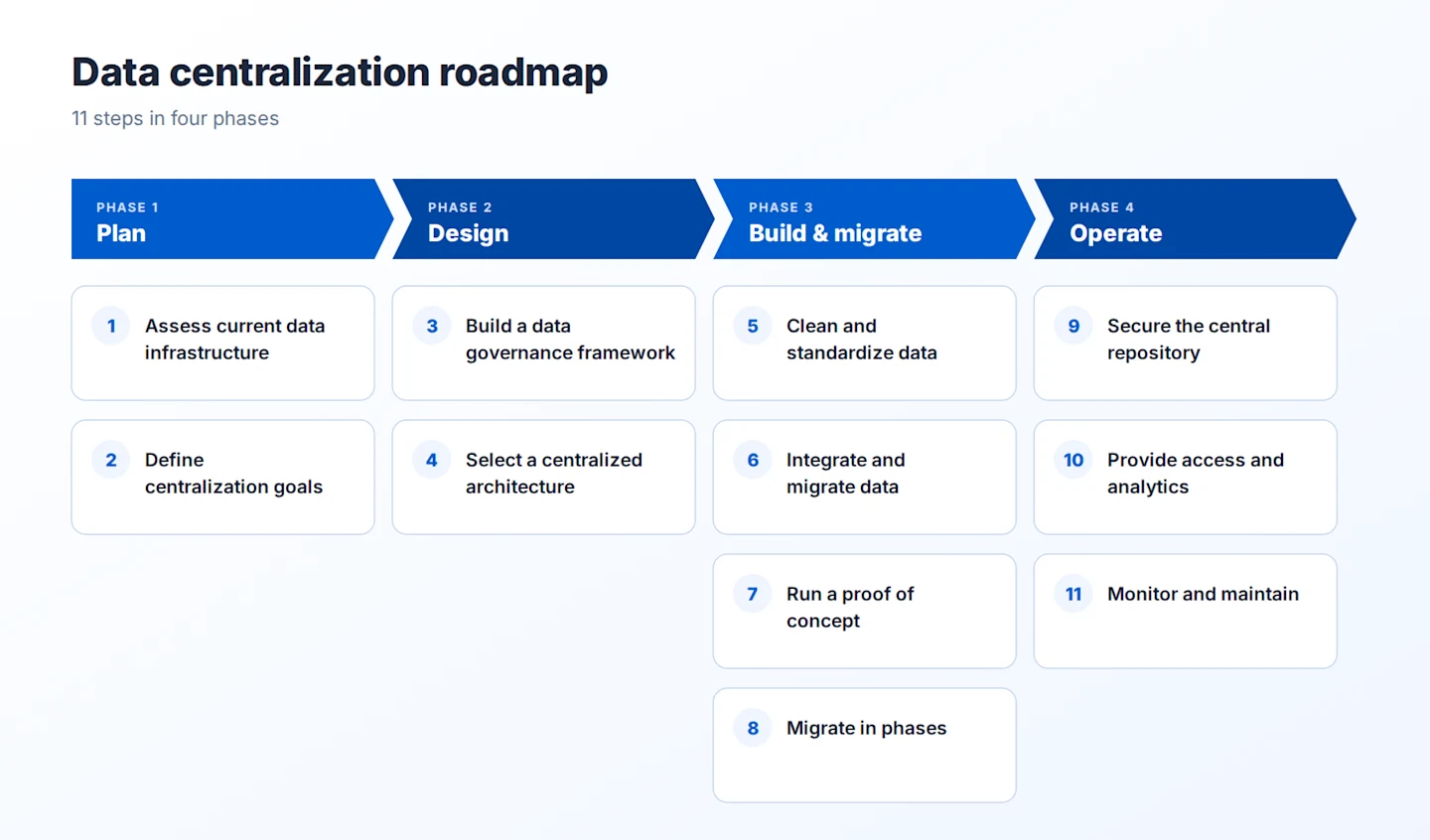
Assessing your current data infrastructure: Before centralizing data, evaluate your existing data infrastructure. Identify and document the current systems and tools, assess data quality, and identify any gaps or redundancies. For example, during the assessment, you may discover that different departments within your organization use multiple data sources, resulting in data duplication and inconsistencies.
Define data centralization goals: Clearly define the goals and objectives of centralizing organizational data. Determine what benefits you aim to achieve, and how centralization aligns with your organization’s broader objectives. Are you hoping to achieve improved data quality? Or does your business require streamlined compliance? These are some questions your data centralizing plan should have answers to.
Develop a data governance framework: Establish a data governance framework to manage the centralized data. Define data ownership and stewardship, access controls, and security policies. Set data quality standards, naming conventions, and metadata management practices, and document data definitions and lineage. Schedule regular policy reviews.
Select a centralized data architecture: Choose the architecture that fits your needs: a cloud data warehouse, a data lake, a hybrid lakehouse, a master data management (MDM) system, or a centralized database. Evaluate data volume, velocity, variety, and the complexity of your analytics requirements.
Clean and standardize data before migration: Remove redundancies, standardize formats, and enforce validation rules so that bad data isn’t copied into the new repository.
Integrate and migrate data: Develop a strategy for data integration and migration using data integration tools, ETL or ELT processes, or your preferred method for efficient data movement.
Run a proof of concept: Test the pipeline with a subset of data to find issues before full-scale deployment.
Migrate in phases: Move data source by source or department by department to minimize downtime and risk.
Secure the central repository: Encrypt sensitive data, and set up access controls, audit trails, and monitoring. This is especially important because a single central repository can become a single point of failure.
Provide data access and analytics capabilities: Enable easy access to centralized data for users across the organization. Implement self-service analytics tools, data visualization platforms, or BI (Business Intelligence) solutions to empower users to derive insights and make data-driven decisions.
Monitor and maintain centralized data infrastructure: Continuously monitor and maintain the centralized data infrastructure to ensure performance, reliability, and scalability. Monitor data quality and address issues promptly to optimize resource utilization.
Data centralization tools
Most data centralization projects use tools from several of these categories:
Tool category | What it does | Examples |
Data integration and ETL/ELT tools | Extract data from sources, transform it, and load it into the central repository on a schedule or in real time | Astera Data Pipeline, Informatica, Fivetran |
Cloud data warehouses | Store structured data centrally for analytics and reporting | Snowflake, Google BigQuery, Amazon Redshift, Azure Synapse |
Data lakes and lakehouses | Store large volumes of raw, semi-structured, and unstructured data | Amazon S3, Azure Data Lake Storage, Databricks |
Data governance and catalog tools | Track ownership, lineage, quality rules, and access policies | Microsoft Purview, Collibra, Alation |
BI and analytics tools | Let teams explore and report on centralized data | Power BI, Tableau, Looker |
When comparing tools, look at scalability and performance, integration capabilities (connectors to your sources), automation and orchestration, AI and ML support, and cost efficiency. See our list of the top data integration tools to compare options.
Key challenges in implementing data centralization
Organizations must navigate a series of technical and operational hurdles to integrate various data sources into one unified system.
Integration complexity: Merging various data sources with differing formats and standards demands robust data transformation and data mapping tools to ensure consistency.
Legacy systems and data silos: Outdated systems and isolated repositories hinder seamless integration as they lack modern integration capabilities, resulting in fragmented data landscapes. Integrating legacy systems requires specialized strategies to modernize and consolidate data effectively.
Security concerns: Consolidating sensitive data into one repository amplifies the risk of a single breach affecting the entire dataset, necessitating enhanced security protocols and strict adherence to regulatory compliance.
Scalability issues: Ensuring that the centralized infrastructure scales with data volume is challenging as it involves managing exponential data growth, which requires significant upgrades and optimization. The need to dynamically allocate resources, optimize data processing, and reconfigure systems without causing disruptions makes scalability a complex issue.
Best practices for successful data centralization
The success of data centralization depends on a well-planned approach. Beyond the roadmap above:
Start with the highest-value use case, such as monthly financial reporting, and expand from there.
Get business owners involved early, so the central repository reflects the definitions teams actually use.
Use multi-cloud and hybrid architectures to prevent vendor lock-in and ensure redundancy.
Use serverless data processing to match computing resources to actual usage.
Apply AI-driven tools to automate anomaly detection, data classification, and predictive analytics.
How Astera streamlines data centralization for enterprises
Astera Data Pipeline is an enterprise-grade data integration solution for creating and managing automated data pipelines. The AI-powered platform enables enterprises to consolidate company-wide data into the destination of their choice.
The platform’s capabilities span a wide range, from reading various file sources and database providers to supporting diverse file formats and transfer protocols. With over 100 connectors, integration across popular databases like Oracle, SQL Server, and cloud platforms like AWS S3, Google Cloud, and Azure becomes seamless.
Designing and scheduling dataflows for automated execution becomes straightforward with Astera’s built-in job scheduler, allowing complex task sequences to be easily visualized and implemented.
Ready to see it in action? Sign up for a demo or start a 14-day free trial now!
Centerprise Can Make Your Data Centralization Process Fast and Easy – Try it Today!
Automate the process using Astera Centerprise’s simple drag-and-drop interface, connect to all the popular databases and cloud platforms, design and schedule dataflows and workflows… and more – all without writing any code!
