

Most conversational analytics tools on the market today are competing on readiness, cool UI, or an expansive list of graphs. The chat interface gets the attention, the model choice gets the marketing, and the demos all focus on how natural the question-to-answer experience feels. What rarely gets discussed is the data layer that sits beneath all of it, which is the layer that actually determines the production robustness of the “AI-driven” analytics platform.
The lack of focus on the data layer is the reason so many AI analytics deployments stall after the first demo. The demo works because someone curated a clean CSV for it. However, real enterprise data does not arrive as curated CSVs. It arrives fragmented across operational systems that are difficult to join, with overlapping keys that do not actually match, and with business logic that lives in the heads of analysts rather than in any system of record. A language model on top of that situation can produce a confident-sounding answer, but the answer will often be wrong in ways that are difficult to detect.
The lesson that experienced data teams keep relearning is that the analytics layer is only as trustworthy as the foundation it sits on. If you want reliable answers to business questions, you need a properly constructed data foundation underneath the chat interface. That foundation is more than a single database. It includes the data pipelines that move data from source systems, the metadata that describes how those systems relate to one another, the access plan the AI agent uses to retrieve data at query time, and optionally a data warehouse that organizes the data for faster analytical access.
What a Real Business Question Actually Requires
Consider the kind of question a business leader in a logistics and trucking company actually wants to ask: which of our drivers are the least profitable per mile, and why?
On the surface this looks like a single analytical query. In practice it requires data from at least three operational systems that are disjoined from one another. Trip revenue lives in the transportation management system, or TMS. Driver hours and pay rates live in the payroll and hours-of-service, or HOS, logging system. Fuel consumption and equipment data live in the fleet telematics platform. None of these systems shares a common driver identifier out of the box. None of them store profit per mile as a calculated field. And the definition of profit per mile itself involves a formula that has to be agreed on before any calculation makes sense.
An AI chat interface with no data foundation behind it cannot answer this question reliably. It might query one system and miss the other two platforms. It might guess at how to join records and produce a number that does not survive scrutiny. It might invent a calculation that does not match how the business actually thinks about profitability. The model is doing its best with what it has, but what it has is not enough.
For AI to answer this question reliably, several things need to be in place. There needs to be a documented understanding of which systems hold which data and how their entities relate to one another. There needs to be a pipeline that can extract the relevant data, harmonize the identifiers, and bring everything together in a form that can be queried as a unified view. There needs to be a clear definition of the profit-per-mile formula and the input it consumes. And there needs to be an execution layer that can run queries against this consolidated view on demand. With all of this in place, a natural-language query can produce an answer that holds up. Without it, the chat layer is simply improvising.
The Foundation that Makes the Chat Layer Trustworthy
This is where Astera’s approach differs from most AI analytics offerings. The platform treats the data foundation and the chat interface as two halves of the same product, rather than as separate concerns that someone else is responsible for stitching together. As explored in Foundation First: Why Model-Agnostic Data Platforms Win, the underlying data layer is what separates a demo from a production system.
In the logistics and trucking company scenario, Astera Intelligence inside Centerprise AI reads the requirements document provided by the analyst, identifies the relevant source connections, and builds the dimensional model from scratch. It reverse-engineers the schema of each source system, adds a union staging model that combines the schema, and then creates a dimensional model with fact tables and dimension tables. The agent designs and generates the pipeline in a visual designer, as defined in the requirements document. After reviewing the dimensional model, the analyst executes the pipeline autonomously, with a real-time job trace logging every table created and populated.
By the time the analyst opens Astera Studio to ask the profitability question, the warehouse is already there, populated, and conformed.
When the question comes in through Studio’s chat interface, the AI agent does not have to guess how to join three operational systems. It reads the metadata from the driver profitability Skill file, which describes the dimensional model structure and the profit-per-mile formula. It generates a dataprep script that expresses the analytical intent against the appropriate fact and dimension tables. Astera Dataprep is the governed execution layer that sits between the AI and the warehouse, which validates the script under strict select-only and read-only access rules and fetches the data from the datawarehouse which is Snowflake in this example.
The resultant data table is fed into the Studio’s analytics library, which renders the ranked horizontal bar chart in response to the analyst’s question.
The AI never reads a row of data. It works entirely from the metadata in the Skill and the schema description in the dimensional model.
The chart is trustworthy because the underlying foundation is trustworthy. The written analysis that comes alongside it points to something the company could actually act on: three drivers are clustered 24-25% below the fleet average, which suggests a systemic issue rather than individual outliers. The recommendation is to audit those drivers’ HOS logs for excess idle hours and compare their route assignments against the top performers.
The recommendations are only as good as the data pipeline behind it. It would point in the wrong direction if, let’s say, the pipeline joins drivers to the wrong trips, or if the on-duty hours are fetched without accounting for non-billable detention time. The reason it points in the right direction is that the pipeline, the metadata, and the data model provides a reliable foundation, together with dataprep that spawns run-time scripts against each question asked by the analyst.
What Gets Missed When the Data Infrastructure Is an Afterthought
When teams try to bolt conversational analytics onto whatever data infrastructure already exists, three problems tend to surface.
The first is that the AI is forced to do schema interpretation on the fly. Every question becomes an exercise in figuring out which tables to use, which keys to join on, and whether the field called customer_id in one system means the same thing as cust_no in another. Results vary from query to query, and the user has no visibility when the agent guessed correctly versus when it produced a confidently wrong answer.
The second is that business logic ends up scattered across prompts. The definition of profit per mile, or active customer, or qualified lead, lives wherever the last analyst typed it into a chat box. Two people asking what looks like the same question get different answers because they phrased the calculation slightly differently. To get around it, the organization needs a single source of truth for the data, and a library of agreed-upon logic, that the chatbot can refer to for every question.
The third is that performance degrades the moment the question gets ambitious. Asking a language model to reason across raw operational tables works for simple lookups. It falls apart on the kind of analytical questions that actually matter to a business, which usually involve aggregations, time comparisons, and multi-table joins. A properly constructed data foundation, with data integration pipelines that harmonize data across sources and metadata that documents how entities relate, is designed specifically to make those queries fast and reliable. Skipping this data engineering step just pushes the cost into every individual query.
Why This Architecture Wins
The data foundation matters for AI analytics because that is where the business definitions, entity relationships, and data quality decisions are established. Three artifacts do this work together: a pipeline that harmonizes identifiers across source systems, metadata that documents what each entity represents, and a model that captures how the business thinks about its data. Together these artifacts turn raw operational records into something an agentic AI system can analyze with confidence.
The Astera approach of having the AI build the foundation itself is also what makes the architecture practical at design-time. The historical objection to building robust data pipelines and dimensional models was that the work was slow and expensive. Building a star schema from a half-dozen source systems used to take a team of data engineers several weeks at minimum. With Astera Intelligence handling the schema reverse-engineering, model design, and pipeline generation autonomously, that timeline collapses from weeks to hours. The foundation gets built quickly enough that skipping it is no longer a reasonable trade-off.
The pipeline moves and harmonizes data across source systems. The data warehouse holds the consolidated data in a form that supports analytical queries. The Skill file encodes the metric definitions and business logic that give those queries meaning. The AI reads the metadata and generates the scripts. Dataprep executes them under governed access rules. The analytics library renders the results. No layer is asked to compensate for weaknesses in another. For a deeper look at how this all fits together, see Introducing Agentic Warehouse and Reliable Analytics Powered by Centerprise AI.
The Takeaway
Building a trustworthy AI analytics platform starts with the right data foundation. Join our live webinar — How to Build an Enterprise Data Foundation for Reliable Analytics and AI — on July 15 and see Centerprise AI in action on real data. Reserve Your Seat
Organizations that get this right will end up with an analytics platform that scales beyond the demo. Their business users will trust the answers they get back, because the answers will be consistent, accurate, and tied to a real model of the business. Organizations that skip the foundation will end up with a chat interface that looks impressive in isolation and disappoints the moment anyone tries to use it for a decision that matters. See how Astera’s AI agent builds a full data warehouse from a single prompt to understand what this looks like end-to-end.
The conversational layer is only as good as the data foundation behind it. Build the data layer first, and every analyst conversation becomes trustworthy by design.
To see how Astera Intelligence builds production-ready dimensional warehouses and data pipelines from a single natural-language requirement, schedule a personalized demo with our team.
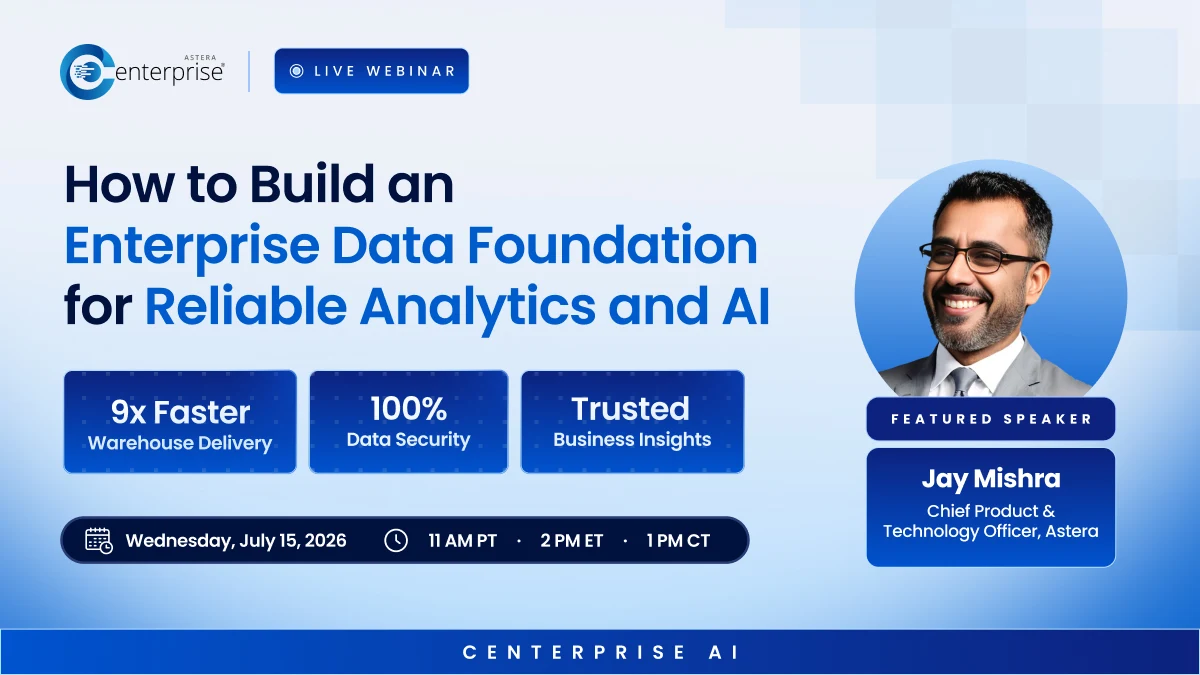
Building a trustworthy AI analytics platform starts with the right data foundation. Watch our webinar — How to Build an Enterprise Data Foundation for Reliable Analytics and AI — on July 15 and see Centerprise AI in action on real data.