

This roundup is built from verified user sentiment compiled from G2, Capterra, PeerSpot, Gartner Peer Insights, and vendors' own official pricing pages. Quotes are paraphrased except where direct quotations are clearly marked and kept under 15 words. Every pro and con traces back to a named review platform, and every rating is the platform's current aggregate at the time of writing.
Six tools show up consistently across independent comparisons of AI OCR software: ABBYY Vantage, Google Cloud Document AI, Amazon Textract, Rossum, Nanonets, and Astera ReportMiner.
Setup complexity is genuinely universal: every product here has reviewers noting a real learning curve on complex documents. Five of six are effectively single-purpose: AP-only (Rossum, Nanonets), RPA-anchored enterprise (ABBYY), or cloud-native developer APIs (Google, AWS). ReportMiner is the one product whose own reviewers describe using it across report types none of the other five users' reviews mention.
Here is what actual users say about each product.
1. Astera ReportMiner
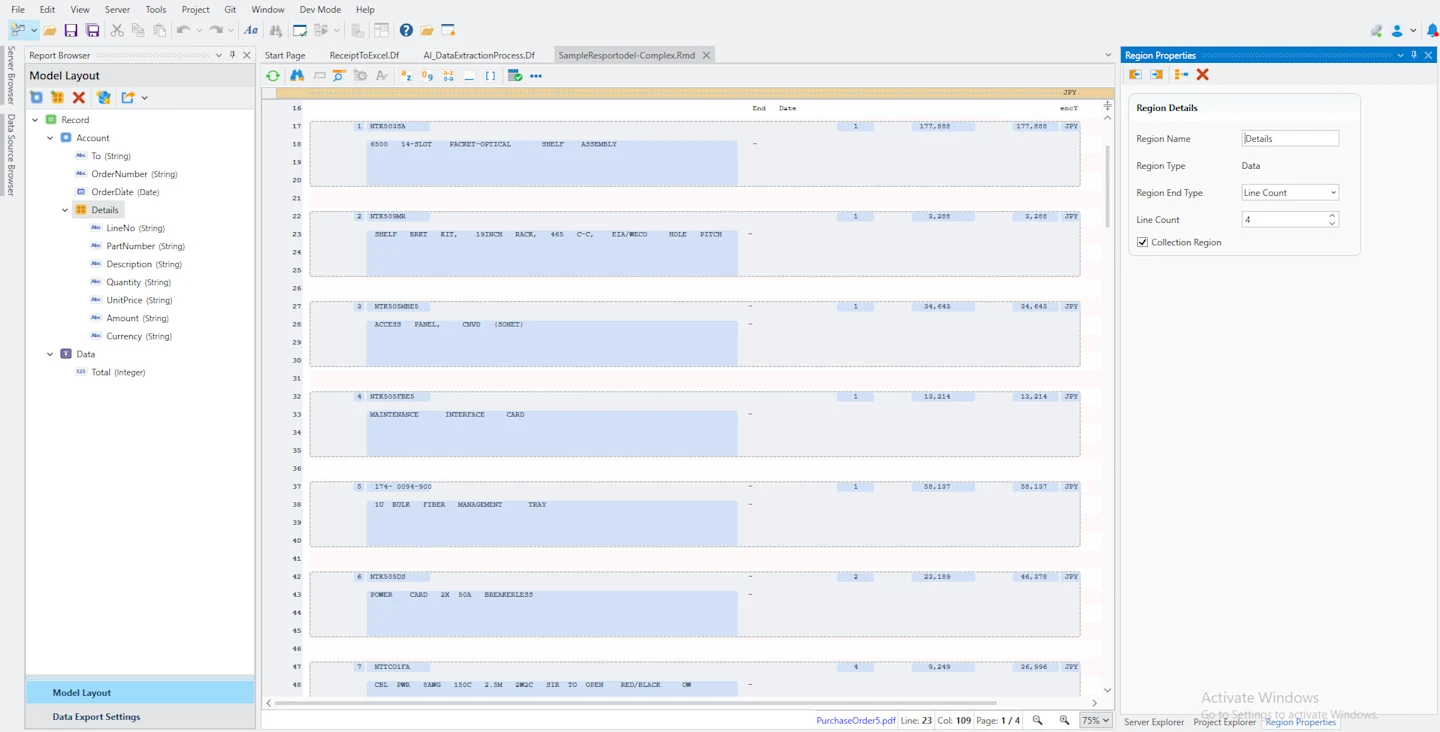
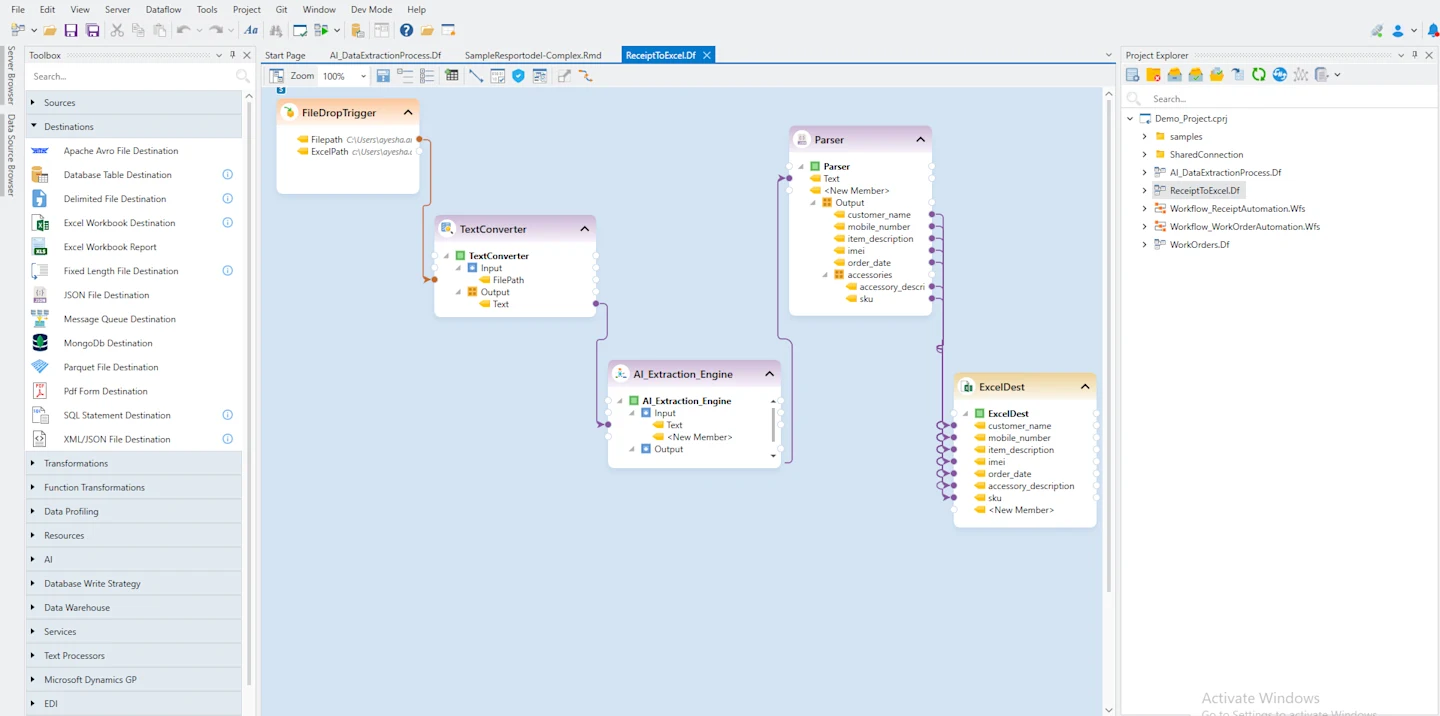
Combines AI-driven and template-based extraction to turn unstructured documents into structured data, with built-in OCR and no per-page pricing complaints surfacing anywhere in its review set. ReportMiner's own reviewers describe a genuinely wider range: invoices, pay stubs, bills of lading, purchase orders, bank statements, text reports, Excel files, EDI files, sometimes in the same pipeline. It also serves several industries and use-cases, with no limit on document type, and is designed for high-speed, high-volume document processing. It also offers a comprehensive suite of data quality, ETL, and 300+ connectors. Some non-technical users find setup the tricky part.
Pros
ReportMiner's built-in OCR and its performance on scanned and handwritten documents of varying quality have been well-praised in multiple reviews across G2 and Capterra.
It handles high-volume, highly variable documents well; one reviewer processing 10,000 to 15,000 invoices a month from 3,000+ vendors cut per-invoice processing time by 95% (G2).
Reusable report models save real time on repeat formats, and several reviewers contrast this favorably against the tool they switched from (Capterra).
AI-driven field interpretation handles untemplated layouts automatically, and template-free extraction runs smoothly on unseen layouts — a combination that doesn't show up in Rossum's or Nanonets' own reviews (G2).
Award-winning support team with excellent response time. One reviewer specifically mentioned "great support – just amazing response time and effort to help you" (Gartner).
Pricing doesn't show up as a complaint anywhere in ReportMiner's reviews, unlike ABBYY, Google, AWS, Rossum, and Nanonets, where it's a top complaint in every single review set.
Cons
Complex or irregular layouts carry a real learning curve, noted across multiple reviews spanning several years (G2).
Extraction accuracy can dip on poor-quality scans, though built-in validation catches most cases before they reach downstream systems (G2).
ReportMiner has no built-in document storage or archiving; that layer is handled by other systems (G2).
The G2 review sample is smaller than the category leaders (19 reviews, versus 96–127 for Nanonets and Rossum), worth being upfront about.
2. ABBYY Vantage / FlexiCapture
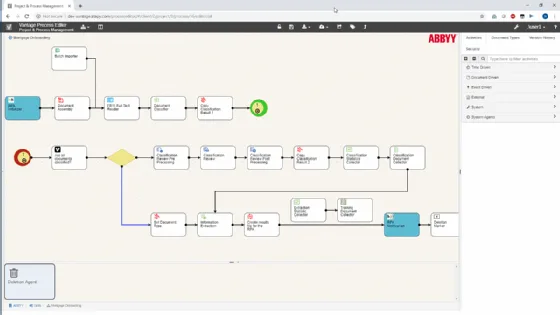
Enterprise-anchored, and one of the longest-tenured players in intelligent document processing (IDP). Vantage is the cloud-native, low-code cognitive product, while FlexiCapture is the older on-prem line, less cognitive but proven at scale. Pricing is consumption-based per page, running to five and six figures annually at enterprise volume.
Pros
OCR and handwriting accuracy are the most cited strengths on G2 and PeerSpot, with one PeerSpot reviewer putting handwriting recognition accuracy at roughly 70%.
Support for 200+ languages is a genuine differentiator for global enterprises, though accuracy gaps remain in specific scripts (Gartner).
Prebuilt integrations with UiPath, Blue Prism, Automation Anywhere, and SharePoint, plus a marketplace of prebuilt models, shorten time to value (G2).
Cons
Setup is the most repeated complaint: Capterra and G2 reviewers agree implementation requires real expertise or partner involvement (5+ mentions).
Pricing runs high at enterprise scale; per-page consumption pricing is a recurring theme and PeerSpot's mindshare tracking shows buyer engagement fell from 13.6% to 5.0% YoY.
Reviewers report software bugs and stability issues in the Advanced Designer, with no reliable autosave (G2).
3. Google Cloud Document AI
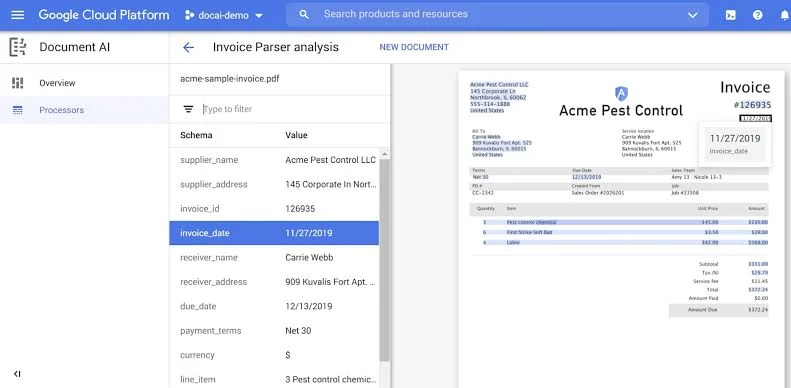
Hyperscaler OCR and document-parsing API suite, priced per page and tightly coupled to the GCP ecosystem. Enterprise Document OCR runs $1.50 per 1,000 pages, while Form Parser and Custom Extractor processors run $30 per 1,000 pages.
Pros
Accuracy holds up on degraded scans; one reviewer said it handled blurred and rotated documents better than other services they tested (G2).
Integration is straightforward for teams already on Google Cloud, and prebuilt parsers reduce setup time (G2).
Cons
Pricing is the single most repeated complaint, with 9+ combined mentions on G2; specialized processors at $30 per 1,000 pages escalate quickly at volume.
The real total cost of ownership runs well above the sticker price; independent estimates put 40 to 80+ engineering hours needed to build a production pipeline.
4. Amazon Textract
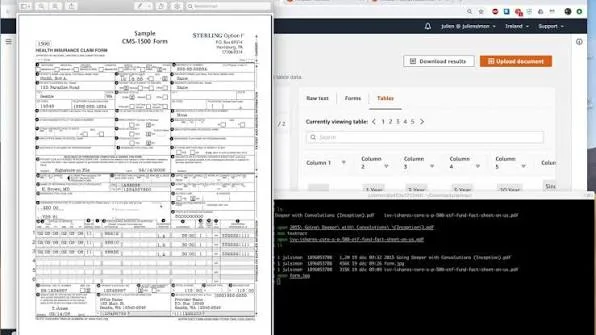
AWS-native OCR and extraction API family. Raw text detection runs $1.50 per 1,000 pages, but Forms and Tables detection jumps to $15–$50 per 1,000 pages — a 10x to 47x swing depending on which API call is made.
Pros
Printed and handwritten text extraction is accurate, the most frequently cited strength (G2).
Processing is fast and ingestion is straightforward, with fine-tuned control over extraction settings (G2).
Cons
The pricing structure is counter-intuitive: the same page can cost 10x to 47x more depending on which API feature is enabled, per AWS's own pricing page.
Teams without prior AWS experience run into a real barrier, since getting full value requires AWS infrastructure fluency (G2).
5. Rossum
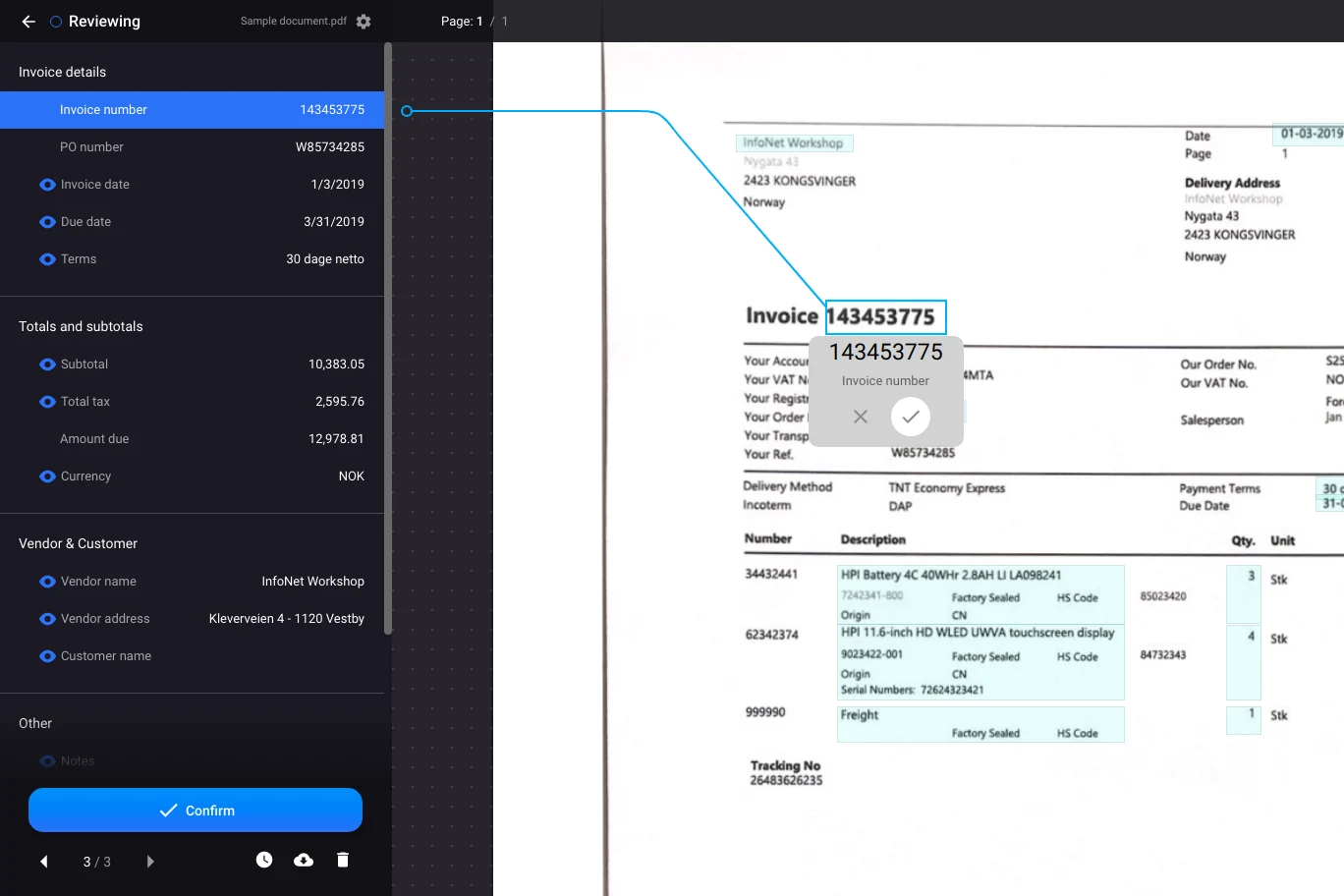
Cloud-native IDP focused on accounts payable and invoice processing, acquired by Coupa in 2026. The Starter plan floors at $18,000 per year. Praised for its intuitive UI and AP performance; accuracy drops on other document types and non-English languages.
Pros
The interface is intuitive and adoption is fast, the most repeated praise in the review set, mentioned in 20+ G2 reviews.
The system learns from corrections over time; several reviewers report 80 to 90% automation rates, and one team cited 20 working days saved per month (G2).
Cons
Cost is the #1 complaint: at the $18,000/year Starter minimum, that works out to $30 per invoice at 50 invoices a month.
Official language support covers only 7 languages, a real gap for global operations.
6. Nanonets
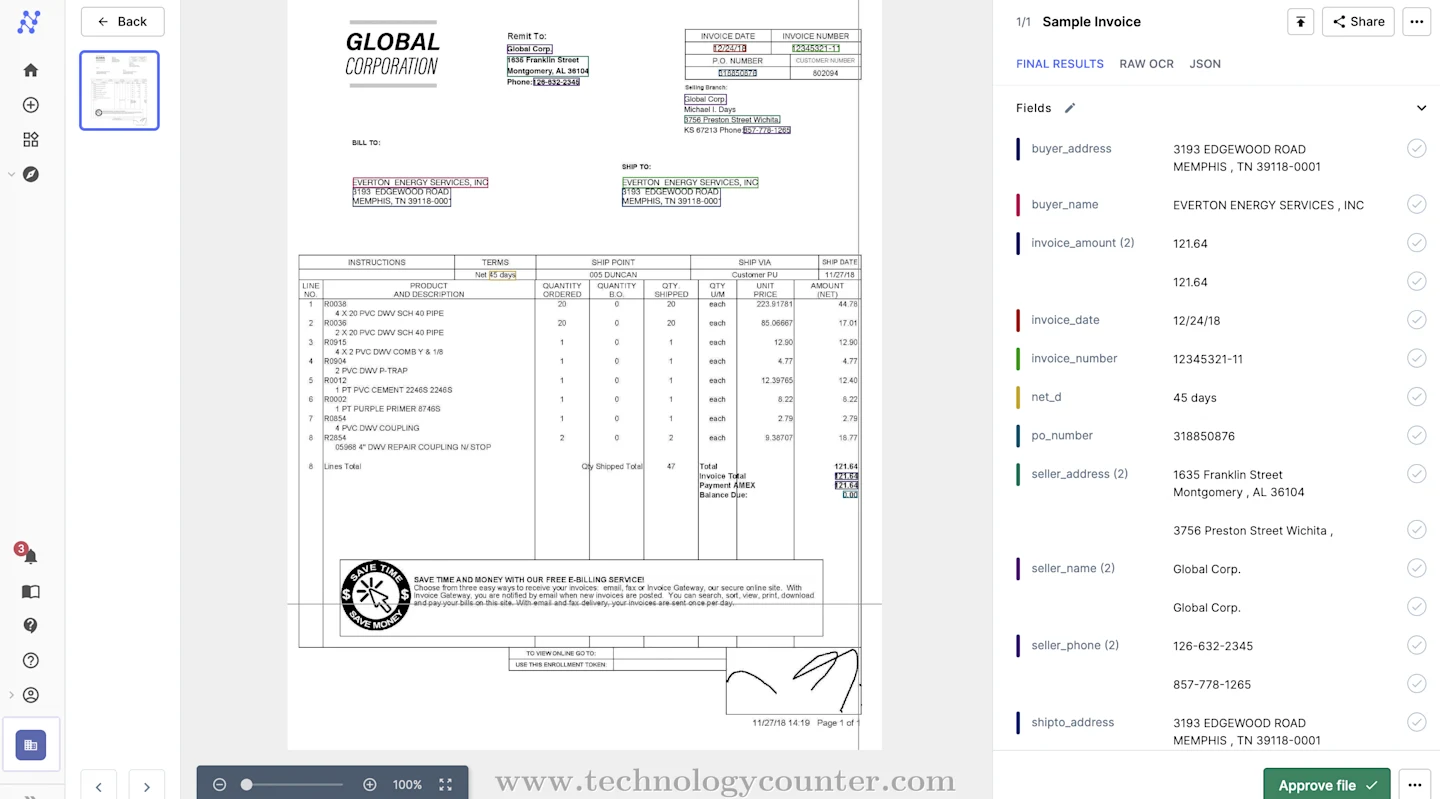
Mid-market, API-first, usage-based block pricing (~$0.30 per page, $499/month Pro plan). Markets itself as serving 34% of Fortune 500 companies. Strong on ease of use; struggles with complex or uncommon document layouts.
Pros
Ease of use is the most cited strength, especially for non-technical users who get onboarded fast (Capterra, G2).
Ratings stay consistently high, 4.7 to 4.9 out of 5 across G2 and Capterra.
Cons
Pricing is unpredictable at scale: per-page block pricing plus add-on fees make total cost hard to forecast — the #1 negative theme on G2.
Trained models are proprietary and can't be exported or migrated to another platform, a real vendor lock-in risk.
Why ReportMiner Wins the Conversation
Rossum floors at $18,000 a year. Nanonets' per-page blocks make cost unpredictable. Google and AWS see pricing as the #1 or #2 complaint, with the same page costing up to 47x more depending on which API call you make. None of that shows up in ReportMiner's own review set.
ReportMiner runs on a fixed annual subscription with no per-page fee and no cap on document volume or type, the main reason why its own reviewers never raise pricing as a complaint.
ReportMiner's reviewers describe invoices, pay stubs, bills of lading, bank statements, text reports, and Excel files often in the same pipeline. Rossum and Nanonets reviewers describe AP and invoice use cases only.
Forty minutes to under 2 minutes per invoice, at 10,000–15,000 invoices a month across 3,000+ vendors, is a sharper number than anything cited in Rossum's or ABBYY's own reviews.
The honest caveat: ReportMiner's G2 and Gartner review count is smaller than Nanonets' or Rossum's, so lean on the strength and specificity of what reviewers say rather than the volume.
See how Astera ReportMiner handles a scanned document mix that would need three different point solutions elsewhere. Book a Demo