

The invoice data extraction software you use to process your invoices can be the difference between financial chaos and clarity. For instance, with accurate data, your accounts payable team can ensure timely payments, strengthen supplier relationships, and avoid any unnecessary complications. Plus, working with reliable data lets you keep everything running smoothly and confidently.
So, how do you achieve this financial clarity? By making sure your invoice data extraction is on point.
Which comparison do you need?
Digitizing paper and scanned invoices: invoice scanning software
Handling the full invoice step, from capture to approval: best invoice processing software
Automating all of accounts payable, from capture to payment: best AP automation software
Pulling fields and line items from invoices: you are at the right place. This guide will give you all the information.
Types of Invoice Data Extraction Software
Invoice data extraction tools fall into a few categories, and the right one depends on how varied your invoices are and how much you want to automate. Here’s how the main types compare in buying terms. For how each method works under the hood, see our invoice data extraction guide.
Type | What it does | Best for | Trade-off |
|---|---|---|---|
OCR software | Turns scanned or image invoices into machine-readable text | Digitizing paper and simple layouts | Struggles with varied or complex layouts; fields still need capturing |
Template-based software | Extracts fields using a saved layout for each vendor | Stable, repeating formats | Breaks when a layout changes; high upkeep across many vendors |
AI / IDP platforms | Read invoices by meaning, with no template per vendor | Many vendors, changing formats, high volume | More capable, so test accuracy on your own invoices |
All-in-one data platforms | Extraction plus validation, transformation, and delivery to your systems | Teams that want capture-to-ERP in one tool | More than a point tool; pays off when you also move the data |
The Case for Invoice Data Extraction Using AI
Invoice data extraction is a use case ripe for AI. Here’s why:
Need for accuracy. Invoices carry loads of information, but the key is to extract all the required fields accurately. This can be a challenge considering invoices are typically unstructured and follow different templates.
Varying formats. Organizations typically receive invoices in different formats, such as paper, scanned, emails, PDFs, spreadsheets, and EDI (electronic data interchange) files. This requires a solution that can adapt to the changing formats.
Resource-intensive. Depending on the size and complexity of the operation, your AP team likely deals with hundreds, if not thousands, of invoices. This takes up considerable resources that can potentially be saved using AI.
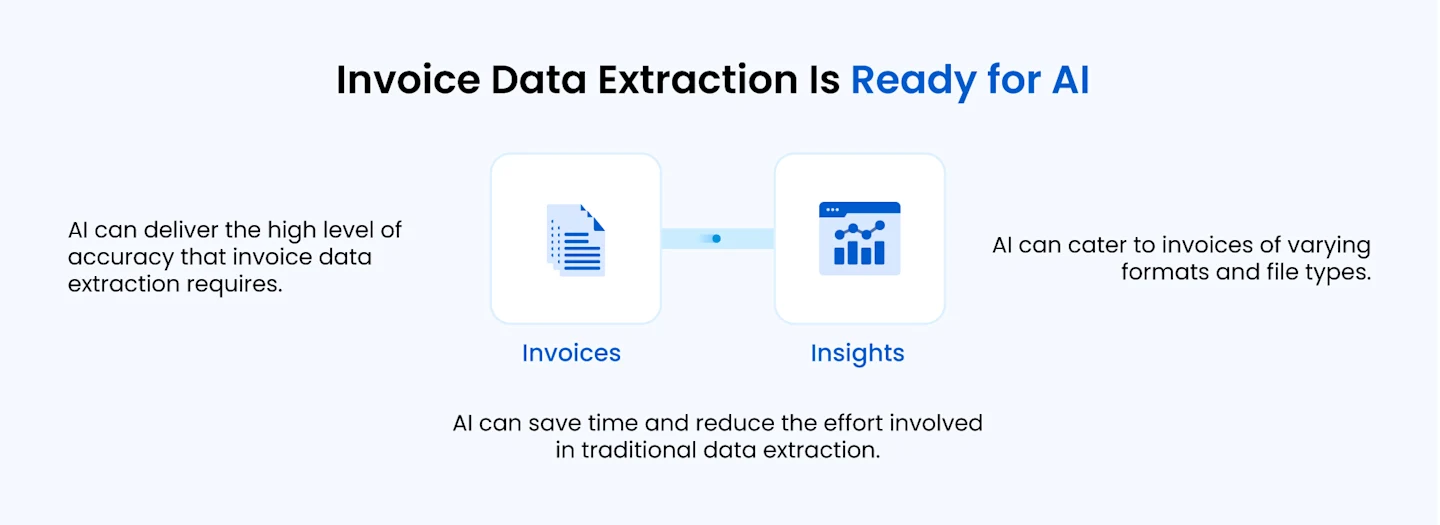
Automated invoice processing using AI is several times faster and more accurate than conventional approaches and can process invoices with various formats and changing layouts. By leveraging technologies like LLMs, RAG, and ML, AI-powered solutions can automate the invoice extraction process for you.
The 8 Best Invoice Data Extraction Software
How We Evaluated These Tools
We compared the tools below on the factors that matter most for invoice data extraction:
What we looked at | Why it matters |
|---|---|
Extraction accuracy | How reliably the tool pulls fields and line items across varied invoice layouts. |
Template handling | Whether it needs a template per vendor or reads new layouts on its own. |
Formats and sources | Support for PDFs, scans, email, Excel, and EDI. |
Integration | How cleanly it delivers data to your ERP, accounting system, or database. |
Scale | Whether it holds accuracy and speed at high invoice volumes. |
Ease of use | How much technical skill or setup the tool requires. |
Pricing clarity | Whether costs are transparent, including per-document or tier fees. |
1. Astera
Astera is a no-code data platform whose AI-powered Intelligent Document Processing handles invoice data extraction end to end. Here’s what it does:
Features
Template-Free Extraction: Astera reads invoices and pulls fields and line items into structured data without a saved template for each vendor, so new and varying layouts don’t need setup.
AI-Assisted Template Creation: For high-volume, repeating layouts, Astera’s AI recommends and builds the extraction model for you across many files at once.
Multi-Page Invoices: It processes multi-page invoices, including line-item tables that span pages, and merges the result into one clean record.
Scanned and Image Files: Built-in OCR reads scanned PDFs and images alongside digital files, so paper invoices are handled too.
Your Choice of AI Model: The LLM Generate feature works with providers such as OpenAI and Llama, as well as your own custom model.
AI-Based Mapping: Astera’s AI Automapper matches the extracted fields to the structure your destination system expects.
Validation and Transformation in One Flow:A library of built-in transformations lets you clean, validate, and reshape the data before it loads.
Automation: Schedule the flow or trigger it on events like a file drop, so invoices process without anyone starting the job.
Delivery to Your Systems: Astera writes the data to databases, files such as Excel and CSV, and EDI, and connects to your ERP and other systems.
No-Code: Everything runs in a drag-and-drop interface, so AP and finance teams can own it without engineering help.
Benefits
Proven at scale: GaP Solutions, an Australian retail technology provider, processes thousands of invoices a month across around 3,000 vendor layouts with Astera. It also reduced the time spent on invoice processing by 99.79%. As its director, John Goodacre, put it: "once it's set up, it works 100% of the time." Read the complete case study.
A choice of five OCR engines: Astera lets you pick the OCR engine that suits your documents: Paddle, Tesseract, Google OCR, Amazon Textract, or an LLM-based custom engine. That makes it easier to get accurate results from clean PDFs and low-quality scans alike.
200+ built-in transformations: Once data is extracted, you can clean, validate and reshape it inside the same flow, so invoices arrive in your ERP or database in the format it expects.
No-code Platform for Non-technical Users: As a no-code platform, Astera offers ease of use to users with little or no expertise. Plus, the availability of relevant resources, robust customer support, and training courses means you can become proficient in no time at all.
Scale Your Invoice Processing From Hours to Minutes with Automation
GaP Solutions cut their invoice processing time from 24 hours down to just 3 minutes. Looking for a similar solution tailored to your specific requirements?

2. UiPath IXP (Document Understanding)
UiPath IXP (Intelligent Xtraction and Processing), part of the UiPath Platform, is UiPath’s document processing product. It includes the capabilities previously sold as UiPath Document Understanding and adds generative AI extraction for structured and unstructured documents.
UiPath IXP’s ML and generative AI capabilities extract data from invoices and other documents, and it can automate document processing tasks to reduce manual effort and dependency on human intervention.
The solution may be unfeasible for smaller clients, primarily due to the huge price difference between its basic and advanced tiers. Some users have claimed that its signature and handwritten text recognition can be improved, while the solution also struggles with extraction and classification for documents containing long tables and line items.
3. ABBYY Vantage (and FlexiCapture)
ABBYY Vantage is ABBYY’s current intelligent document processing platform, and it uses pre-trained skills for common documents such as invoices. ABBYY FlexiCapture, the company’s long-standing capture product, is still available for existing deployments.
The solution enables efficient data extraction by simplifying rule configuration and automating tasks, boosting workflow efficiency and reducing costs.
However, FlexiCapture users report challenges with text recognition in smaller fonts and certain letters, impacting accuracy, especially with unstructured files. Additionally, ABBYY FlexiCapture’s complexity requires training, making it challenging for non-technical users.
4. Nanonets Invoice OCR
Nanonets is an AI-based document processing platform that uses machine learning models to extract data from invoices and other unstructured documents, eliminating manual data entry in the process.
Nanonets offers document classification and extraction capabilities that use AI for unstructured data extraction from a variety of formats. The solution also provides templates and pre-built models depending on the popular use cases.
On the other hand, users have complained that the output is limited when the solution is implemented on-premises. Some features can be improved to increase the overall usability of the platform. For instance, tagging documents like invoices and mapping all the details can be time-consuming. Similarly, users have pointed out that training custom models can be time—and resource-intensive, and the workflow management setup can benefit from more checkpoints to determine whether data extraction is optimal for the desired output.
5. Docsumo
Docsumo is an intelligent document processing (IDP) platform that classifies, extracts and checks data from documents, with solutions for lending, financial services, insurance, healthcare, logistics and real estate teams.
Docsumo has been praised for its ease of use and customer support. Users have appreciated the solution’s data extraction and data capture capabilities. The solution’s OCR capabilities have been acknowledged for their level of accuracy.
On the flip side, the processing time can be longer than the alternatives, and some users have highlighted occasional issues with data capture accuracy. ML technology has limitations when processing documents with varying formats or if there’s complexity of information within the documents. Some users have highlighted limited options and missing features, but these can vary depending on user-specific requirements.
6. Rossum
Rossum is an IDP solution that extracts data from transactional documents such as invoices using Aurora, its own document AI model. Coupa acquired Rossum in May 2026, so it’s now part of Coupa’s spend management platform. Users report that setup can be complex, so it’s a better fit for companies with technical resources available.
Rossum is known for its data extraction and data capture capabilities. Their customer support is responsive and has received praise from several users. Plus, Rossum’s extraction accuracy has been highlighted by many of its users.
However, Rossum’s users have highlighted that their bigger updates often cause minor issues, and the solution has a lengthy and complex setup and may require technical resources. Plus, it may have limitations when extracting data from certain document types, and pricing starts at $18,000 a year for the Starter plan, which can put it out of reach for smaller teams.
7. Doxis AI.dp (formerly Klippa DocHorizon)
Doxis AI.dp, formerly Klippa DocHorizon, is an intelligent document processing platform that extracts data from invoices, receipts and other documents. SER Group acquired Klippa in 2025, the combined company now operates as Doxis AI.dp in March 2026.
The solution is easy to use, especially for non-technical users. It offers reliable OCR capabilities with support for a variety of documents, and the customer support team is responsive and helpful.
Nevertheless, the solution offers limited customization options, and it may not fully support complex workflows and requirements. Some users have pointed out that its extraction accuracy can drop with varying formats and layouts, and training the model can take a lot of time and resources.
8. Tungsten InvoiceAgility (Tungsten Automation, formerly Kofax)
InvoiceAgility is an invoice automation solution by Tungsten Automation, formerly Kofax. It’s an integrated e-invoicing network and invoice capture solution that accelerates invoice processing while ensuring accuracy and compliance.
The solution is a good option for automating invoice processing and while the AI isn’t perfect, it’s comparatively accurate when extracting data. Plus, it can process high volumes of invoices.
Conversely, the UI is difficult to navigate and can be made simpler and user-friendly, and licensing costs are too high and only suitable for large-scale enterprises with no options for smaller operations. Some users have pointed out that their customer support can be more responsive and helpful. Moreover, training and expertise are required to use the solution.
From 24 hours to 3 minutes per invoice
How GaP Solutions turned a 24-hour invoice job into a 3-minute one.
What To Look For In An Invoice Data Extraction Software
If you're still unsure which invoice processing solution is a good fit for you, here are some things to look for before you seal the deal:
AI Capabilities
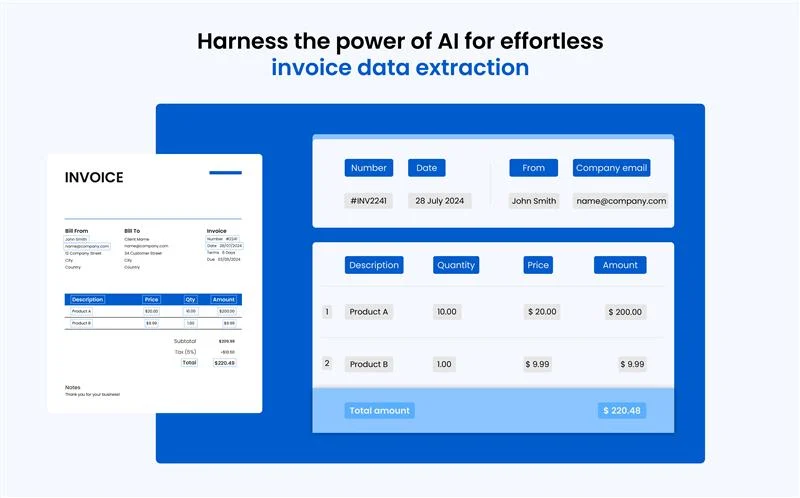
AI is here to stay, and it appears to be tailor-made to resolve the challenges associated with invoice data extraction. From automating the end-to-end process to improving efficiency and increasing accuracy, selecting a solution with AI capabilities will not only benefit you now but future-proof your invoice processing. Plus, solutions that leverage technologies like RAG and NLP allow you to do more than just process your invoices. For instance, with RAG and LLMs, you can talk to your data and extract valuable insights that can augment your decision-making in real-time.
Volume and Complexity
While invoices are crucial almost everywhere, the volume and complexity can vary significantly. It’s important to see if the solution you select can meet your requirements in terms of the volume of documents you’ll be processing daily. Solutions with AI and parallel processing capabilities are recommended as they are adept at dealing with varying formats, different file types, and large volumes of data.
Budget and Additional Costs
While budget consideration is pretty self-explanatory, it’s good practice to make sure that there aren’t any additional costs that you aren’t aware of. For instance, many solutions charge a monthly fee but ask for a premium after you have processed a specific number of documents.
Customizability
Customization is crucial when it comes to document processing, as requirements vary significantly depending on the use case. Considering this, a one-size-fits-all solution may not be the answer, which is why it’s better to go for an invoice data extraction software that offers a certain degree of customizability and control.
Workflows
If you’ll be processing thousands of invoices daily, it’s helpful to look for a solution that can facilitate combining all the extraction tasks in a single workflow or a handful of workflows. This helps streamline all your invoice processing by consolidating all the iterations into a handful of flows instead of having to deal with hundreds or thousands of extraction tasks separately.
Ease of Use
The solutions available on the market can vary significantly in terms of ease of use. Some solutions claim to be easy to use but require a certain degree of technical expertise and coding knowledge. Of course, there are also easy-to-use, no-code solutions that offer a drag-and-drop interface. Make sure that your users’ technical expertise aligns with the solution’s requirements.
How Astera Extracts Invoice Data (A Quick Walkthrough)
Astera uses AI to read invoices with little manual setup, even when layouts vary. Here’s the flow from a PDF invoice to structured data in your system:
Add your invoices. Point Astera at the invoices, whether that’s a folder of PDFs, an email inbox, or a scanned batch. It takes them in bulk.
Let the AI read the document. Astera’s AI model identifies the fields on each invoice, such as invoice number, dates, supplier, line items, tax, and totals. It finds them wherever they sit on the page, so a new layout doesn’t need a new setup.
Review the extracted fields. The captured data appears as structured output (for example, JSON with each line item), so you can confirm it looks right before it moves on.
Validate the data. Built-in checks confirm required fields are present, totals add up, and values check out against reference data such as purchase order records in your database, so errors are caught early.
Send it where it needs to go. The clean data is mapped to the structure your system expects and delivered to your ERP, accounting software, a database, or a file like Excel.
Run it on autopilot. Once the flow is built, schedule it or trigger it on events like a file drop or an email attachment, so invoices process without anyone starting the job.
All of this runs in a no-code, drag-and-drop interface, so your AP or finance team can own it without engineering help.
Concluding Thoughts
Your choice of invoice data extraction software can have far-reaching consequences, not just for your accounts payable team but for your entire organization. With AI arriving on the scene, invoice processing solutions that incorporate it properly can improve their accuracy and help users increase efficiency.
To that end, Astera’s AI-powered Intelligent Document Processing is a next-gen solution featuring market-leading data extraction and document processing capabilities, AI-driven features to automate the entire workflow, and an intuitive drag-and-drop interface that takes all the hassle out of processing invoices.
Get in touch today to see how it works.
See invoice processing in action
See how Astera captures, extracts, validates, and delivers invoice data to your ERP.