
Data integration has long been one of the most time-intensive parts of enterprise IT. Connecting multiple systems, reconciling formats, and ensuring data reaches its destination reliably often requires weeks of preparation before the first record moves. But with AI-powered integration, that timeline compresses dramatically. What once took weeks can now be designed, validated, and delivered in minutes.
Why AI-Powered Integration is Necessary
Enterprises today depend on dozens of systems — Salesforce for customer data, Oracle for transactions, Snowflake for analytics, and countless others across the cloud and on-prem. Each system excels in its own domain. The challenge comes when leaders need a unified view across them.
Traditional integration means:
- Configuring every connector manually.
- Writing transformation logic to standardize formats.
- Building mappings field by field.
- Defining destinations and load strategies one pipeline at a time.
These steps are critical, but they don’t need to be manual anymore.
How Astera Reimagines Integration
Astera Centerprise brings AI into the heart of integration. Instead of assembling each component step by step, teams simply describe their intent, and the platform builds the workflow.
- Sources configured automatically. “Connect Salesforce customer data and Oracle transactions.” Connectors are provisioned, and metadata is read instantly.
- Transformations described in plain language. “Standardize phone numbers, calculate lifetime value, and join orders with customers.” AI designs the transformation logic.
- Destinations defined with precision. “Load into Snowflake, partitioned by region.” The schema and load strategy are created automatically.
- Mappings aligned intelligently. AI recognizes that Cust_ID and CustomerNumber represent the same field and reconciles differences in data types.
- Pipelines generated end-to-end. With one command, an integration flow is ready to run – complete with scheduling, validation, and monitoring.
Every element of integration — sources, transformations, destinations, and mappings — is orchestrated through AI. Teams review, approve, and proceed with faster, smoother workflows.
Integration in Action
A financial services company used Astera to merge customer data from Salesforce with financial records in Oracle and deliver a unified view in Snowflake. What would normally require weeks of configuration was achieved in days:
- Connectors set up automatically.
- Hundreds of fields mapped in minutes.
- Business rules defined in plain language, translated into transformations.
- Incremental updates ensured analytics stayed current without overloading systems.
The result was a 360-degree customer view that powered analytics, reporting, and compliance monitoring, all delivered faster than ever before.
Why It Matters
Integration is the foundation of every data-driven initiative – analytics, reporting, customer experience, and compliance all depend on it. By embedding AI into the process, Astera enables organizations to:
- Accelerate delivery timelines.
- Reduce reliance on manual configuration.
- Keep pipelines adaptable as systems evolve.
- Ensure reliable, repeatable outcomes at scale.
Integration That Moves as Fast as Your Business
With Astera, integration is no longer a manual build – it’s a capability activated through AI. From defining sources to shaping data, setting destinations, and generating flows, the platform turns intent into execution in a single step.
Getting Started with AI-Powered Integration
Organizations moving to AI-powered integration typically follow three steps. First, they identify high-impact pipelines where manual configuration creates the most delay. Second, they use natural language commands to describe integration requirements, allowing the platform to generate initial workflows. Third, they review AI-generated pipelines, make adjustments as needed, and deploy with confidence.
This approach works for teams with varying technical backgrounds. Data engineers reduce time spent on repetitive tasks, while business analysts contribute directly to pipeline design without writing code. The platform handles connector provisioning, field mapping, and transformation logic automatically, while teams maintain control over validation and approval before deployment.
Conclusion
The question facing enterprises isn’t whether integration matters—it’s whether integration speed can match business velocity. Organizations that reduce pipeline configuration from weeks to minutes gain the flexibility to respond when opportunities emerge or requirements shift. AI-powered platforms make this possible by handling tasks that previously required manual effort: connector setup, field mapping, transformation logic, and workflow orchestration. When integration becomes a capability that teams activate rather than a project they build, data flows at the pace business demands.
Experience AI-Powered Integration with Astera
Astera Centerprise delivers the infrastructure needed to make this shift. The platform combines natural language-based pipeline design with automated connector management, intelligent field mapping, and built-in validation—reducing configuration overhead while maintaining the control technical teams require. Organizations use it to handle diverse integration challenges: batch data loads, incremental CDC updates, API-based real-time synchronization, and multi-system orchestration.
Teams typically begin with a specific integration challenge—merging customer data across CRM and ERP systems, automating warehouse updates, or exposing data through APIs. The platform generates initial workflows based on natural language descriptions, then allows engineers and analysts to review, refine, and deploy with full visibility into transformation logic and data flow.
Ready to see how AI-powered integration works with your data architecture? Schedule a consultation to discuss your specific integration requirements.
Patient care systems don’t shut down for maintenance. Emergency rooms process admissions at 3 AM. Surgical units access medical histories mid-procedure. Yet healthcare organizations still face a persistent challenge: moving years of clinical data, billing records, and operational systems to modern platforms without interrupting any of these critical functions.
This operational reality creates a specific technical problem. Traditional database migrations require scheduled downtime—maintenance windows where systems go offline while data transfers between platforms. For industries operating around the clock, these windows don’t exist.
Zero downtime data migration addresses this operational constraint directly. Rather than accepting scheduled outages as inevitable, this approach maintains continuous system availability while transferring data between platforms. The technique has matured from specialized implementations at large tech companies to practical solutions accessible to mid-sized healthcare organizations.
Understanding how zero downtime data migration works—and what distinguishes it from traditional approaches—clarifies why it has become the preferred method for organizations where continuous operations aren’t optional.
Key Takeaways
- Zero downtime data migration is essential in healthcare where clinical, billing, and operational systems must remain available 24/7.
- Traditional migration methods introduce risk with long prep cycles, manual scripts, and disruptive cutovers that can halt patient care and delay revenue.
- Change Data Capture (CDC), incremental synchronization, and automated validation are the core technical foundations that make continuous availability possible.
- Healthcare migrations face unique challenges such as HIPAA compliance, real-time clinical access, and uninterrupted billing workflows.
- Astera’s approach accelerates execution by combining AI-powered schema modeling, auto-generated pipelines, and end-to-end validation in a no-code environment.
- The benefits extend beyond healthcare—industries like finance, retail, manufacturing, and SaaS can also modernize without downtime.
- Best practices include phased execution, comprehensive testing, continuous monitoring, clear rollback plans, and transparent communication.
What is Zero Downtime Data Migration?
Zero downtime data migration transfers data between systems while the source database remains fully operational. Applications continue processing transactions. Users maintain uninterrupted access. The migration happens in parallel with normal operations rather than replacing them during a cutover window.
This approach relies on several technical components working in concert:
Change Data Capture (CDC) monitors the source database’s transaction log, identifying and capturing every insert, update, and delete as it occurs. These changes stream to the target system in near real-time, keeping both databases synchronized throughout the migration period.
Parallel Operations maintain both legacy and modern systems simultaneously during the transition. Applications can read from or write to either system, providing flexibility and safety during cutover.
Incremental Synchronization moves data in controlled phases rather than bulk transfers. Initial loads migrate historical data while CDC handles ongoing changes. This staged approach allows validation at each step and reduces the risk of discovering issues only after cutover.
Automated Validation continuously compares source and target data at multiple levels—schema structure, record counts, field values, and referential integrity. Discrepancies surface immediately rather than appearing as production issues after migration completes.
The business value becomes clear in operational terms. A regional hospital network processes approximately 2,000 patient registrations daily. Each registration triggers updates across scheduling, billing, and clinical systems. A four-hour maintenance window for migration would halt 300+ registrations and cascade through every department. Zero downtime data migration eliminates this operational disruption entirely.
Gartner research indicates that only 17% of data migration projects are able to meet budgets or deadlines. Healthcare organizations face additional complexity: regulatory requirements demand complete audit trails, and any data access interruption can affect patient outcomes. Studies show that less than 40% of healthcare organizations execute system transitions without significant operational disruptions.
Why Healthcare Demands Continuous Availability
Healthcare systems operate under constraints that make traditional data migration approaches impractical. Clinical staff need immediate access to patient histories during treatment decisions. Laboratory systems post results that trigger time-sensitive interventions. Pharmacy systems validate medication orders against allergy records and contraindications. Emergency departments can’t queue admissions until database maintenance completes.
HIPAA regulations require administrative, physical, and technical safeguards protecting electronic protected health information. Migration processes must maintain these protections continuously—no gaps where audit trails pause or access controls suspend during data transfer. Healthcare organizations face penalties averaging $1.5 million for HIPAA violations, making compliance gaps during migration a significant risk.
Revenue cycle operations compound these data migration challenges. Healthcare billing systems process insurance claims worth millions in daily revenue. Claims submission windows are time-sensitive—delays can result in denials requiring costly manual appeals. A billing system outage doesn’t just inconvenience staff; it directly impacts organizational cash flow.
Consider a practical scenario: A 400-bed hospital processes approximately $2.8 million in billable services daily. A traditional migration requiring 24 hours of downtime would delay claim submissions for that entire amount, pushing collections weeks into the future. Zero downtime data migration keeps billing operations running throughout the transition.
How Traditional Migration Creates Unnecessary Risk
Legacy database migration approaches follow patterns developed for smaller data volumes and more tolerant operational environments. Teams extract data from source systems, transform it to match target schemas, and load it during a scheduled maintenance window. This extract-transform-load (ETL) approach worked when databases measured in gigabytes and organizations could schedule weekend downtime.
Modern healthcare data environments have outgrown these assumptions. A mid-sized hospital network typically maintains 20-50 terabytes of structured clinical data, plus unstructured data in imaging systems and document archives. Transferring this volume requires substantial time—time during which source systems must remain offline to prevent data inconsistencies.
Manual script development adds complexity. Each data source requires custom extraction logic. Every transformation rule needs coding and testing. Schema mappings between source and target must be documented and validated. Development cycles for these custom scripts can extend for months, and the scripts themselves become brittle—breaking when source schemas change or new data types appear.
The result: Projects that overrun timelines and exceed budgets while still carrying significant cutover risk. Teams schedule the migration multiple times, discovering new issues during each rehearsal. When production cutover finally occurs, it happens under intense time pressure with limited rollback options.
Laying the Groundwork for a Successful Migration
Every migration begins with careful preparation. Before data moves, teams establish scope, dependencies, compliance requirements, and system readiness. This stage is not a delay—it’s what ensures a smooth, predictable transition.
In healthcare, where systems support patient histories, billing, and clinical data, preparation takes on added importance. Mapping interdependencies, aligning with regulatory standards, and validating operational continuity are essential steps that set the stage for success.
By investing in this groundwork, organizations create a clear migration blueprint that accelerates execution and delivers results faster.
Real-World Scenario: Healthcare System Overhaul
A regional healthcare provider needed to move patient records, appointment histories, billing systems, and clinical data from multiple on-premise legacy databases to a modern cloud platform such as Snowflake.
The goals were to:
- Expand analytics capabilities.
- Strengthen compliance with healthcare regulations.
- Improve patient experience with faster access to accurate data.
To achieve this, the migration plan ensured uninterrupted operations across scheduling, billing, and clinical applications while the transition was in progress.
Key Considerations in Migration
Every migration program involves multiple dimensions that must align for a successful outcome.
Extended Timelines Before Execution
Large-scale migrations often spend more time in preparation than in actual execution. Teams can spend weeks documenting dependencies, validating compliance, and aligning systems before the first record is moved. Without automation, these planning cycles extend delivery timelines and delay access to the benefits of modernization.
Regulatory Compliance
Healthcare data migration requires strict validation protocols. Every step in the process must maintain HIPAA compliance and ensure complete accuracy.
Operational Continuity
Systems that support patient care need continuous availability. Migration strategies are designed to keep legacy and target systems running side by side until the transition is complete.
Comprehensive Validation
Testing before, during, and after migration ensures that every record and schema aligns with operational and regulatory expectations.
The Astera Approach in Action
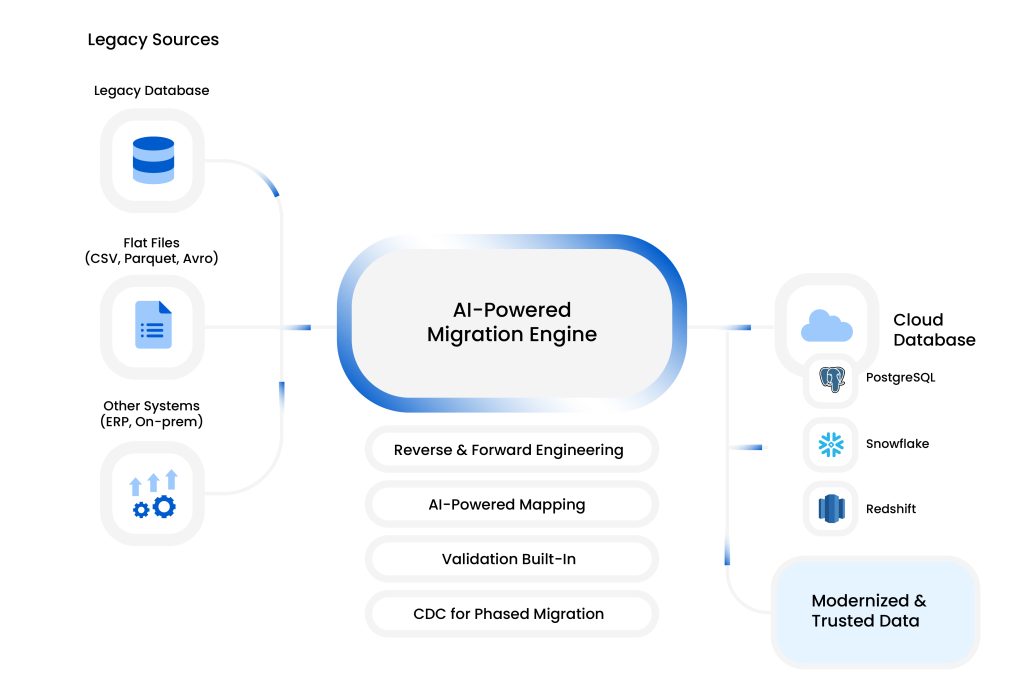
Astera Data Pipeline unifies migration activities—schema alignment, data movement, and validation—in a single no-code platform. What sets it apart is the combination of AI-powered automation and data model-driven design, which together enable faster, more intelligent migration pipelines.
Step-by-Step Solution
Faster Kickoff with AI-Driven Automation
Astera shortens the time between planning and execution. Using AI-assisted modeling, schema discovery, and auto-generated pipelines, teams can move from blueprint to migration in days instead of weeks. Automation accelerates preparation and gives organizations a head start toward modernization.
Continuity Throughout Migration
Change data capture (CDC) and staging environments enable phased transitions where both legacy and cloud systems remain available.
AI-Powered Modeling and Auto-Generated Pipelines
Astera combines model-driven design with AI intelligence to simplify migration end to end. Teams can define the target data model visually or in plain language, and the platform automatically generates the migration pipelines needed to deliver it. Intelligent algorithms detect schema differences, align fields, and propose mappings across systems. With pipelines ready to run, teams simply review and approve, ensuring consistency, scalability, and repeatability with minimal manual effort.
Automated, Iterative Testing
Verification checks, detailed job traces, and reconciliation confirm accuracy at schema, field, and record levels.
End-to-End Validation and Monitoring
Quality checks, job traces, and alerts provide full visibility into migration progress and outcomes.
Traditional vs. Astera Migration Workflow
Data Migration is Now as Easy as a Conversation
Type in your instructions in natural language and transform your data migration processes in real time. Learn all about Astera Data Pipeline and what it can do for your use case.
Contact Us Today!
Results in Practice
For the healthcare provider, Astera enabled:
- Continuous operations, ensuring uninterrupted access to patient services.
- AI-assisted mapping and auto-generated pipelines, reducing setup time significantly.
- Validated accuracy, with reconciliation built into every pipeline stage.
- Weeks to delivery, with a clear, repeatable process ready for future migrations.
Why These Outcomes Matter Across Industries
The same framework applies beyond healthcare. Finance, retail, manufacturing, and other industries all benefit from:
- Multi-type migration support in one unified platform.
- AI-assisted schema alignment and pipeline generation, reducing project timelines.
- Built-in compliance and validation, ensuring trust in every record.
- Model-driven pipelines, making migrations consistent and repeatable.
Technical Foundations: Understanding CDC
Change Data Capture deserves attention as the core technology enabling zero downtime data migration. CDC operates by monitoring database transaction logs rather than querying tables repeatedly. When an application updates a patient record, the database writes the change to its transaction log—a sequential record of all modifications. CDC reads these logs, identifies relevant changes, and streams them to the target database.
This log-based approach offers several advantages. Reading logs imposes minimal overhead on the source database—typically less than 2% CPU utilization. Applications experience no performance degradation from migration activities. CDC captures every change, including updates and deletes that periodic queries might miss.
Modern CDC implementations work across different database platforms and handle complex scenarios including schema evolution during migration. For healthcare implementations specifically, CDC maintains the complete audit trail required for HIPAA compliance while enabling continuous synchronization.
5 Best Practices for Zero Downtime Data Migration
Organizations implementing zero downtime data migration should follow several proven practices:
- Phased Execution breaks large migrations into manageable increments. Rather than migrating all databases simultaneously, organizations migrate systems in priority order—starting with less critical applications and progressing to core production systems. Each phase provides learning that improves subsequent migrations.
- Comprehensive Testing in staging environments identifies issues before production migration. Full rehearsals should replicate production volume, transaction rates, and application behavior. Multiple rehearsal runs allow teams to refine procedures and build confidence before production cutover.
- Performance Monitoring establishes baselines before migration and tracks metrics throughout the process. Comparing post-migration performance against baselines quickly identifies degradation requiring optimization. Monitor transaction response times, query performance, and system resource utilization.
- Clear Rollback Procedures define how to reverse migration if critical issues emerge. While zero downtime data migration reduces cutover risk, organizations still need documented procedures for reverting to source systems if necessary. These procedures should be tested during migration rehearsals.
- Stakeholder Communication keeps all affected parties informed throughout migration. Regular status updates prevent surprises and maintain organizational confidence. For healthcare migrations, daily updates to clinical staff and IT operations ensure everyone understands progress and any temporary constraints.
Cross-Industry Applications
Zero downtime data migration addresses operational requirements extending beyond healthcare. Financial services institutions process transactions 24/7 across global markets. Payment processors handle billions in daily transaction volume. A four-hour maintenance window for database migration could affect millions of transactions and violate service level agreements with merchants.
E-commerce platforms face similar constraints. Online retailers can’t schedule downtime during peak shopping periods, but delaying migration during slow periods pushes modernization efforts months into the future. Zero downtime enables infrastructure upgrades without impacting customer experience or revenue.
Manufacturing operations depend on real-time data for supply chain coordination and production scheduling. Downtime in manufacturing execution systems can halt production lines. Zero downtime data migration keeps these systems operational while moving to modern platforms.
SaaS applications serving thousands of customers must migrate without affecting any tenant. Multi-tenant architectures amplify migration complexity—each customer may use different features and require different customizations. Zero downtime approaches let SaaS providers upgrade infrastructure systematically, validating each migration before proceeding.
Migration That Moves Business Forward
With Astera, migration is more than data transfer—it’s an intelligent, AI-powered process designed for speed and trust. By accelerating kickoff with auto-generated pipelines, ensuring continuous operations during transition, and embedding compliance and validation at every step, Astera helps teams modernize confidently while keeping business priorities at the center.
Experience Zero Downtime Data Migration with Astera
Astera Data Pipeline delivers the complete solution for zero downtime data migration:
AI-Powered Automation: Build migration pipelines in minutes using natural language commands. Describe your target model and the platform generates the complete migration workflow.
Model-Driven Design: Define your schema once and automatically generate all necessary pipelines. Changes propagate instantly—no manual updates required.
No-Code Simplicity: Visual interface enables business users and technical teams to collaborate effectively. No coding required for even complex migrations.
Enterprise-Scale Performance: Handle petabyte-scale migrations with built-in optimization and parallel processing.
Built-In Compliance: HIPAA, GDPR, SOC2—compliance features are standard, not add-ons.
Continuous Validation: Automated reconciliation and quality checks ensure accuracy from first record to final cutover.
Organizations using Astera Data Pipeline complete migration and consolidation projects up to 90% faster than traditional approaches while maintaining zero downtime throughout the process.
Ready to modernize your data infrastructure without operational disruption? Schedule a personalized consultation to see zero downtime data migration in action.
What is zero downtime data migration?
How do you achieve zero downtime during migration?
What are the challenges of zero downtime data migration?
What are the benefits of zero downtime data migration?
How does zero downtime cutover work?
What is Data Cleaning?
Before jumping into AI data cleaning directly, let’s first understand data cleaning itself.
Data cleaning, also known as data scrubbing, is a critical data preparation step where organizations remove inconsistencies, errors, and anomalies to make datasets ready for analysis.
The cleaning process may involve actions like removing null values, correcting formatting, fixing syntax errors, eliminating duplicate data, or merging related fields like City and Postal Code. The end objective is to deliver high-quality, standardized records.
Why is Data Cleaning Important?
Data professionals in enterprise settings need to process a huge amount of source data every day. This data usually comes from various CRMs, spreadsheets, APIs, and departments and often has data quality issues and isn’t necessarily ready for analysis.
Unclean data leads to incorrect insights and cannot be reliably used to support decision-making. Businesses must ensure that their data is healthy before they can derive actionable insights from it to drive growth.
Data cleaning is also a fundamental component of effective data management, essential for keeping data healthy at every stage of its life cycle.
For example, consider the following record in a courier company’s dataset. Through transformation, the information under ‘City’, ‘County’, and ‘Postal Code’ will concatenate with the Address field, providing the complete address for delivery orders.
| Name | ID | Address | City | County |
Postal Code |
What is AI Data Cleaning?
AI data cleaning uses machine learning (ML), AI algorithms, and natural language processing (NLP) to identify errors, duplicate or missing values, and other discrepancies in data. It intelligently learns from data and adapts to complex and evolving patterns. It’s also capable of making predictions about potential data quality issues for example, anticipating where missing values are likely to occur or detecting patterns that may lead to duplicate entries and suggesting the next strategy for resolving them, such as filling gaps, merging duplicates, standardizing formats, or flagging anomalies for review.
Unlike traditional processes, data cleansing using AI doesn’t use rule-based automation, enabling it to save data professionals’ time and effort.
How Does AI Clean Data?
AI-powered platforms use a variety of automation tools and leverage powerful ML and NLP techniques for effective data cleaning:
Machine Learning (ML) Algorithms
These are at the core of the AI data cleaning process:
- Clustering Algorithms: They’re used to group similar data points, to assist in data deduplication (e.g., different spellings of the same name; Sara and Sarah).
- Classification Algorithms: Can categorize data to identify incorrect entries (e.g., flagging an email address in a phone number column).
- Regression Algorithms: Predict missing numerical values using existing variable relationships.
Natural Language Processing (NLP)
This is essential for cleaning unstructured text data.
- Text Normalization: Standardizing text by converting it to lowercase, removing punctuation, and handling contractions.
- Named Entity Recognition (NER): Identifying and categorizing key information like names, organizations, or locations, which helps standardize entries or correcting misspellings in textual data.
- Fuzzy Matching: A technique that finds text strings that are approximately, rather than exactly, equal. This is crucial for detecting “fuzzy” duplicates where there might be minor spelling differences or transpositions.
Key Advantages of AI Data Cleaning
- Informed Decision-Making: AI data cleaning delivers accurate, high-quality, datasets, leading to better data analysis and more reliable business decisions.
- Increased Efficiency: Teams spend less time fixing data issues and more time acting on insights.
- Lower Operational Costs: Prevents expensive mistakes and reduces time spent on manual corrections.
- Compliance and Security: AI data cleaning helps maintain data integrity and adherence to regulatory standards, reducing the risk of breaches and compliance failures.
- Better AI and Analytics Performance: Well-prepared data improves predictive models’ accuracy.
- Consistency Across Systems: Ensures alignment across teams and systems by eliminating discrepancies.
AI Data Cleaning vs Traditional Data Cleaning: By the Numbers
1. Increased Speed
Since traditional data cleaning relies heavily on manual efforts, it makes the process very time-consuming. In fact, a study by CrowdFlower reports that data preparation can take up to 80% of a data analyst’s time.
AI tools can process vast amounts of data in a fraction of the time. Some companies report a 60% faster data verification in finance and a 30% reduction in order processing time in logistics due to AI automation.
2. Increased Accuracy
AI algorithms excel at identifying complex, hidden patterns, anomalies, and correlations that human analysts might miss. For example, a study by McKinsey & Company found that companies using AI for data quality initiatives saw significant improvements in data accuracy and completeness.
3. Scalability and Data Handling
Traditional techniques struggle with complex datasets and are limited to structured data. Scaling up using them becomes a time- and resource-intensive task.
AI-powered platforms are designed ground up to handle large volumes of data. This allows businesses to extract value from data sources previously inaccessible. For example, in fraud detection, AI systems can identify security threats in milliseconds, helping banks save billions annually by detecting fraudulent transactions, as cited by reports on the impact of AI in finance.
Case Study: Turning a Month of Data Cleaning into 6.5 Hours with AI
To understand the advantages of AI-driven data cleaning, consider a real-world scenario in the events industry. A mid-sized company was working with a so-called ‘spreadsheet from hell’ with over 50,000 customer records containing highly inconsistent company names — the same firm appeared under fifteen different name variations (e.g., both Siemens and Siemens AG) and about half the entries had missing names altogether.
How did they solve it?
They applied an AI-driven strategy to rapidly match and consolidate duplicate entries. They first used external reference data to auto-correct known company names and then used algorithmic similarity detection to group the variant names.
In the final step they deployed a machine learning model to make nuanced last-mile judgments on whether name variations referred to the same company names.
By contextualizing industry and country information through AI, they were able to achieve something that would have been nearly impossible to do manually.
The outcome:
Through AI data cleaning, the organization was able to clean and unify 50,000+ records in just 6.5 hours which would otherwise have happened in a month. This saved them $10k. The cleaned dataset revealed insights that the company wasn’t previously able to see. For example, identifying their top attendee companies and spotting returning customer trends.
Risks Associated with AI Data Cleaning
While AI powered technology brings a lot of speed, efficiency, and scalability, it’s important to acknowledge the risks involved. Understanding these risks allows you to mitigate them and get the most out of your investment.
Bias in Training Data
AI models learn from historical data, and if that data contains biases, the model will replicate them. For example, if a dataset disproportionately flags certain records as errors due to past human oversight, AI might reinforce that bias.
Over-Cleaning Valuable Data
Sometimes AI perceives a valuable data as an outlier. For instance, an unusually large transaction might signal a new sales opportunity.
Data Privacy Concerns
Data often contains confidential information. Without proper measures, AI data cleaning tools could put data safety at risk of non-compliance with regulations like GDPR, HIPAA, or CCPA.
Over-Reliance on Automation
Though AI has advanced significantly, human checks are crucial for ensuring that no incorrect cleaning decisions propagate and damage data integrity.
How to Mitigate These Risks?
- Implement human-in-the-loop validation for critical datasets.
- Use explainable AI techniques to understand why cleaning decisions are made.
- Set clear business rules that guide AI in distinguishing errors from genuine variations.
- Ensure your AI tools comply with security and privacy regulations.
Best Practices for Implementing AI Data Cleaning
Strategic implementation can help your business get the best possible results from an AI-based data cleaning tool. Here are some basic steps to follow:
- Define What “Clean” Means for You
Every business has unique data quality needs. Define acceptable ranges, formats, and validation rules before introducing AI. - Start Small, Then Scale
Run a pilot project with a manageable dataset. This lets you fine-tune the AI’s cleaning logic before deploying it to critical data. - Keep Humans in the Loop
AI yields the best results when a human element is involved. Always review its recommendations, especially in early stages, to catch misclassifications. - Integrate with Existing Workflows
Your AI cleaning solution should plug seamlessly into your ETL pipelines, BI dashboards, and reporting systems. - Continuously Monitor and Improve
Provide feedback to the AI over time so that it learns from it. Data quality is not a one-time thing but an ongoing discipline.
The Future of AI Data Cleaning
In Finance
AI-driven data cleaning is helping financial institutions trim operational costs and reduce risk. A 2023 NVIDA survey found 36% of the financial services professionals reported annual cost reductions of over 10% by the implementation of AI applications in areas like compliance and fraud detection.
Additionally, 46% of executives say AI has enhanced customer experiences. This technology allows banks to spend less time correcting data and more time on strategic insights, setting the stage for smarter, real-time decision-making.
In Healthcare
Dirty or inconsistent data costs the U.S. healthcare industry an estimated $300 billion each year, nearly 14% of total medical expenditure. AI-powered tools can clean and standardize complex patient data much faster than manual methods, improving both clinical workflow and research productivity. By reducing data entry errors, AI enables time-intensive tasks, like data aggregation for clinical trials or administrative audits, to be completed in a fraction of the time, accelerating quality care and operational efficiency.
In E-commerce
Inventory chaos due to poor data can cost retailers up to $400 billion annually in lost sales and efficiency. Retailers report that up to 60% of their inventory records are inaccurate, which leads to issues such as out-of-stocks and misfires in restocking. AI-based data cleaning tools help reconcile and standardize product data across channels in real time, minimizing errors and enabling better forecasting. Automated cleanup of customer and inventory data ensures more accurate recommendations, smoother fulfillment, and an overall improved shopping experience.
By 2030, AI-powered data cleaning will be so seamless that most users won’t even realize it’s happening—yet they’ll enjoy the benefits of consistently reliable, ready-to-use data.
Making AI Data Cleaning Accessible to Everyone
One of the most exciting developments in AI data cleaning is how it’s becoming more accessible—not just to data scientists, but to analysts, marketers, business users, and operations teams alike. Tools are evolving beyond code-heavy environments, empowering users to clean, prepare, and validate data without relying on technical workflows.
Astera Dataprep is one such tool that reflects this shift. It combines the power of AI with a clean, no-code interface and natural language chat. From detecting anomalies and missing values to standardizing formats and previewing every transformation live, it makes data cleaning feel approachable—even for those without a technical background.
For teams looking to reduce manual effort, accelerate time-to-insight, and maintain high-quality datasets at scale, tools like Astera Dataprep represent a new chapter in intelligent data management.
Discover AI Data Cleaning with Astera
Learn how Astera Dataprep prepares your data in minutes using an AI-powered, chat-based interface.
Contact Us

Kelly McCabe
Managing Director,The Mortgage People

Ayesha Amjad
AI Product Architect & Mortgage Document Processing Expert

Sudais Baig
Host
Ever noticed how you’re always getting relevant ads, whether you’re streaming on Netflix or shopping on Amazon? Or how sometimes, just thinking about something seems to make it appear on your phone? It feels like every application somehow knows what you’re thinking, serving up personalized suggestions with high precision.
Ever wondered how this is happening? It’s the revolution of AI data analysis, using AI algorithms. These algorithms analyze browse behavior, purchase history, and real-time timing patterns to deliver recommendations tailored exactly to each user. Now, imagine that same intelligence, embodied in proactive AI agents, applied to your business. These intelligent AI tools can empower data professionals and teams across departments to forecast performance, personalize content, and surface actionable insights that truly drive strategic objectives far beyond what traditional KPIs alone can reveal.
This is the cutting edge of smart, data-driven decision-making today: guided by human intuition, driven by comprehensive data analysis, and powered by AI agents.
What is Data Analysis?
Data analysis means to inspect, clean, transform, and model your data to make informed decisions. Before AI came into the picture, data analysis was predominantly manual and relied heavily on human expertise and traditional statistical methods. Let’s have a brief look at these conventional approaches:
Traditional Data Analysis Methods
- Manual Data Collection and Entry: Teams collect raw data from various sources and enter it manually into spreadsheets or databases. This makes the process slow, resource-intensive, and often prone to errors, significantly impacting overall data quality.
- Descriptive Statistics: Data analysts summarize past data using metrics like mean, median, mode, and standard deviation to better understand distributions and trends.
- Inferential Statistics: Using established methods such as hypothesis testing, regression, and correlation, data professionals make predictions or drew conclusions from sample data.
- Data Visualization: Charts, graphs, and tables are manually created to visually highlight trends and patterns in the data for clearer understanding.
- Reporting: Insights are compiled into static reports that are updated on a set schedule. This limits the ability to make timely, data-driven decisions based on the most current information.
AI-Powered Data Analysis
AI data analysis, or AI analytics, is the application of artificial intelligence techniques, such as natural language processing (NLP) and machine learning (ML), on raw data to uncover patterns, generate predictions, or surface insights.
Using AI for analytics marks a fundamental shift in how we work with data. Traditional data analysis methods rely on fixed rules like hardcoded formulas, manual queries, or predefined filters. In contrast, AI automatically discovers patterns as data evolves and surfaces actionable insights without anyone having to rewrite any rules or formulas.
Here are some key techniques it uses:
- Machine Learning: Learns from past data to detect trends and predict future outcomes.
- Time Series Analysis: Identifies patterns over time for forecasting and monitoring, crucial for predictive analytics.
- Natural Language Processing (NLP): Pulls rich insights from emails, customer feedback, and other text sources.
- Generative AI Tools: Platforms like ChatGPT, Gemini, Claude, etc. allow users to analyze data using natural language prompts, making advanced analytics accessible to everyone without any technical expertise.
Let’s take a marketing team at an eCommerce company as an example. They run multiple campaigns across email, social media, and paid search, and want to understand through data analysis:
- Which campaigns bring the most revenue over the past 6 months?
- What types of customers engage with which content formats (videos, blogs, emails)?
- Are there patterns in cart abandonment during specific times of day or on certain devices?
- What products are trending in different regions and why?
- Which audience segments are most likely to convert based on behavior and demographics?
AI can analyze campaign data, user behavior, purchase trends, and even external signals like time or region to find patterns across these questions. Instead of building dozens of reports, the marketing lead can simply ask question in plain English (leveraging natural language understanding), and get real-time, visual answers powered by machine learning, time series analysis, and NLP.
With AI-powered data analysis, data professionals spend less time crunching numbers and more time optimizing campaigns, leading to faster data-driven decisions, better targeting, and higher ROI.
Traditional vs. AI-Powered Data Analysis: The Numbers Don’t Lie
While traditional data analysis has served us well when it comes to getting insights, the sheer volume, velocity, and variety of modern data mean it struggles to keep pace. AI-powered data analysis, especially with AI agents, offers better efficiency, accuracy, and depth of insight. The numbers clearly illustrate this performance gap:
Speed and Efficiency
| Traditional | AI-Powered |
| Relies heavily on manual data collection, data cleaning, and query writing, which is incredibly time-consuming. Tasks that might take weeks or months can become outdated before completion. | AI-powered data analysis tools can process vast amounts of data in a fraction of the time, often reducing data preparation and analysis time by 50% or more. For instance, some companies report 60% faster data verification in finance and a 30% reduction in order processing time in logistics due to AI automation. |
Accuracy and Insight Discovery
| Traditional | AI-Powered |
| In traditional data analysis, human analysts, no matter how skilled, can miss subtle patterns in large datasets and may inadvertently introduce bias. Insights are often limited to predefined queries. | AI algorithms excel at identifying complex, hidden patterns, anomalies, and correlations that human eyes might miss. Organizations have reported improving data-driven decision accuracy by up to 30% through AI-driven insights. |
Predictive Power
| Traditional | AI-Powered |
| Traditional data analysis is primarily descriptive, focusing on what has happened. Predictive capabilities are often based on simpler statistical models that require constant manual refinement because they lack the adaptability of modern AI algorithms to evolving data patterns . | AI systems leverage advanced machine learning to provide highly accurate predictive analytics. For example, a major credit card company implemented an AI-powered data analysis system for fraud detection that reduced fraudulent transactions by 50% within the first year, saving millions. A manufacturing company saw a 38% reduction in unplanned downtime and 25% lower maintenance costs by using AI-driven predictive maintenance. |
Scalability and Data Handling
| Traditional | AI-Powered |
| Traditional data analysis techniques struggle with large, complex datasets (Big Data) and are largely limited to structured data. Scaling up requires significant manual intervention and resources, hindering efficient data management. | AI analytics platforms are inherently scalable, designed to handle petabytes of both structured and unstructured data (like text, images, and audio). This allows businesses to extract value from data sources previously inaccessible. AI systems can identify security threats in milliseconds, helping banks save $10 billion annually by detecting fraud. |
How to Use AI for Data Analysis
Using AI for Data Analysis
Now that we’ve seen how AI elevates data analysis, let’s explore how you can effectively apply it within your own business.
- Start with the Right Question, Not Just the Data:
To understand what your first step could be for using AI for data analysis, ask yourself the problem statement. Specifically,
What business goal am I going to achieve by using AI for analytics?
A marketer would probably use it to identify current and emerging marketing trends, a salesperson might want to know about the features that are most likely to increase the conversion rate, etc. Pinpointing the right question is the most critical step. AI is a powerful tool, but it can only give you answers if you know what you’re asking. - Select the Right AI Tool:
This is the second step where you need to find the right AI tool that matches your priorities and caters to your business needs. An effective approach would be to create a list of potential tools and rate them on how well they address the pain points and support your data environment. Typically, this means evaluating them on five most common factors: accuracy, explainability, integration ease, security, and cost. - Connect Your Data:
One of the most important factors to consider is the data connectors because an AI platform that cannot establish a secure connection will become another layer of friction. So, analyze which connectors you need to access and analyze data from and ensure that the tool you select supports it natively. It could be databases, spreadsheets, cloud data warehouses and lakes, CRMs, etc. - Prepare Your Data:
To ensure a reliable analysis you need to make sure that your data is prepared well. Nowadays, AI tools seem to be automating and doing just about everything, but they still haven’t reached the level of perfection where we can think of eliminating the human element.
AI-powered tools can detect formatting inconsistencies and identify duplicates, but your domain expertise will remain crucial to review the results. - Use Natural Language to Get Insights:
The use of natural language truly makes AI analytics approachable for anyone and everyone, from business users to data professionals. With conversational AI built into modern analysis tools, you can write prompts in plain English and get the insights you need. For example, a doctor might want to observe data regarding the side effects of a medicine over the span of last 10 years. Now, without AI in the picture, one can imagine how complex this question could be for a business user as it would require them to write a long piece of code. - Act on the Insights (The Human Element):
The final and most important step is decision making. AI can only give you insights based on the information you provide. This means that the output of an AI analysis tool will purely depend upon what data it was fed, how prepared and clean it was, and how effective your prompt was.
AI can only tell you that a particular product is trending, but it’s your team’s domain experience that will develop a strategy to capitalize on that trend. So, the true value of AI analytics does not lie in uncovering patterns, but in enabling faster, more confident, and ultimately, more successful strategic decisions.
Risks and Pitfalls to Watch Out for in AI Data Analysis
AI tools can make data analysis much faster. But they aren’t perfect, and they’re only as good as the information and guidance you provide them. Here are some key challenges to consider when using AI for data analysis:
- Data Quality Still Matters
While AI is great for automated data preparation, your starting data quality is still most important. The rule “garbage in, garbage out” is especially true in the case of AI analytics. If your data is messy, has shortcomings, or is missing records, even the best AI algorithms will struggle to give you results that you can rely on. Some AI tools might not even be able to spot all the hidden issues in your data.
So, before diving deep into AI data analysis, you need to spend time making sure your data is clean and set up correctly. Good data-driven decisions rely on correct and up-to-date information. This shows why human expertise is always needed to manage your data properly.
- Guarding Your Data: Security and Privacy
Microsoft AI Researchers Accidentally Expose 38TB of Sensitive Data
In September 2023, Microsoft’s AI research team unintentionally exposed 38 terabytes of private data, including passwords, secret keys, and internal Teams messages, due to a misconfigured Azure Storage URL. The leak occurred when researchers shared open-source AI training data on GitHub but inadvertently included a link granting access to the entire storage account. This incident underscores the risks associated with improper data handling and the importance of stringent security measures when working with AI technologies.
- You Still Need People
Even the best AI tools and agents can’t replace human expertise. Data scientists are still essential for working with unstructured data, selecting the right AI algorithms, and interpreting predictive insights because AI tools—even though they accelerate analysis— need human expertise to handle complex, messy data and ensure the results are accurate and meaningful.
From Insight to Implementation: Building Your Own AI-Powered Workflows
AI data analysis helps data professionals turn insight into action. While many organizations rely on off-the-shelf AI tools or analytics platforms, some are now going a step further by building custom AI-powered workflows tailored to their unique data and business needs.
One increasingly popular approach is to build AI agents that specialize in specific parts of the data analysis process, from cleaning incoming data streams to summarizing insights in natural language or triggering actions based on predictive trends. These agents can help enable AI-driven processes across departments, making data analysis not only smarter but also more scalable and automated.
For those looking to explore this path, Astera’s AI Agent Builder offers a powerful platform to design, build, and deploy intelligent agents that work seamlessly with your existing data infrastructure.
What Makes Astera’s AI Agent Builder Stand Out?
Unlike tools that require extensive coding, Astera’s platform is:
- Built for all: Be that analysts, business users and marketers.
- Modular: Connect data, define steps, train once.
- Scalable: Start small or build a full multi-agent network.
- Explainable: Each result is backed by context.
Since it’s part of the larger Astera ecosystem, you can integrate it to your ETL pipelines, Data warehouse, Dataprep and more.
Intelligence Isn’t Just Artificial – It’s Augmented
We don’t need AI to replace us. We need it to elevate us.
AI data analysis helps turn overwhelming data into clear direction. It highlights what matters most, reveals blind spots, and surfaces opportunities that would otherwise go unnoticed.
The smartest companies aren’t the ones with the most data. They’re the ones that know how to use it.
Using AI for Data Analysis
Astera Data Prep is an AI-powered, chat-based data preparation tool that lets anyone regardless of technical background clean, transform, and prepare data with ease.
Learn More About Astera Data Prep

Enterprise automation didn’t start with AI agents, but they’ve had a much bigger impact than earlier automation methods, such as software scripts or bots. Modern AI agents can do a lot more than tackle repetitive tasks. They can reason through complicated workflows, choose the best course of action, and access tools to execute said action.
But to do all this, AI agents require interoperability. They need to be able to connect to numerous tools, databases, services, and APIs. This connectivity is what turns agents into automation tools, and the Model Context Protocol (MCP) is a unified way of making it happen.
Enterprise-grade automation demands dual MCP support — AI agents should both act and be acted upon as required for the task at hand. Astera AI’s native support for MCP client and server roles in the same platform helps you create smarter AI agents that act as peers, exchanging knowledge, services, and information with each other.
In this article, we’ll discuss MCP’s role in enterprise AI, how MCP server and client roles vary, and the benefits of combining these roles.
Tool Calling and MCP Architecture in Enterprise AI Systems
Tool calling and MCP are both ways to augment AI agents’ capabilities, but they differ in scope. Tool calling is what an AI model uses during a conversation to invoke predefined functions built into its inference process. The model itself decides which tool to call and when to call it, depending on the conversation.
MCP is an open-source, standardized protocol that Anthropic introduced in late 2024 to unify how AI agents or LLMs connect with various tools and systems. MCP has been described as a “USB-C port for AI agents”, a great analogy for its universality, since it enables any AI agent to plug into any tool or system without bespoke integration.
The two approaches are complementary. Where MCP provides the architecture to enable connectivity with external systems, tool calling is the interface an AI model uses to interact with those systems during a conversation.
In enterprise AI systems, MCP helps AI agents draw from a wider range of data sources and proprietary knowledge bases. This is important because your AI agents need access to business data. The more high-quality, contextually relevant data sources that your agents can tap into, the better they can understand and fit into your business workflows and the more value they can deliver.
It’s not an overstatement to say that MCP contributes directly to your AI agents’ success.
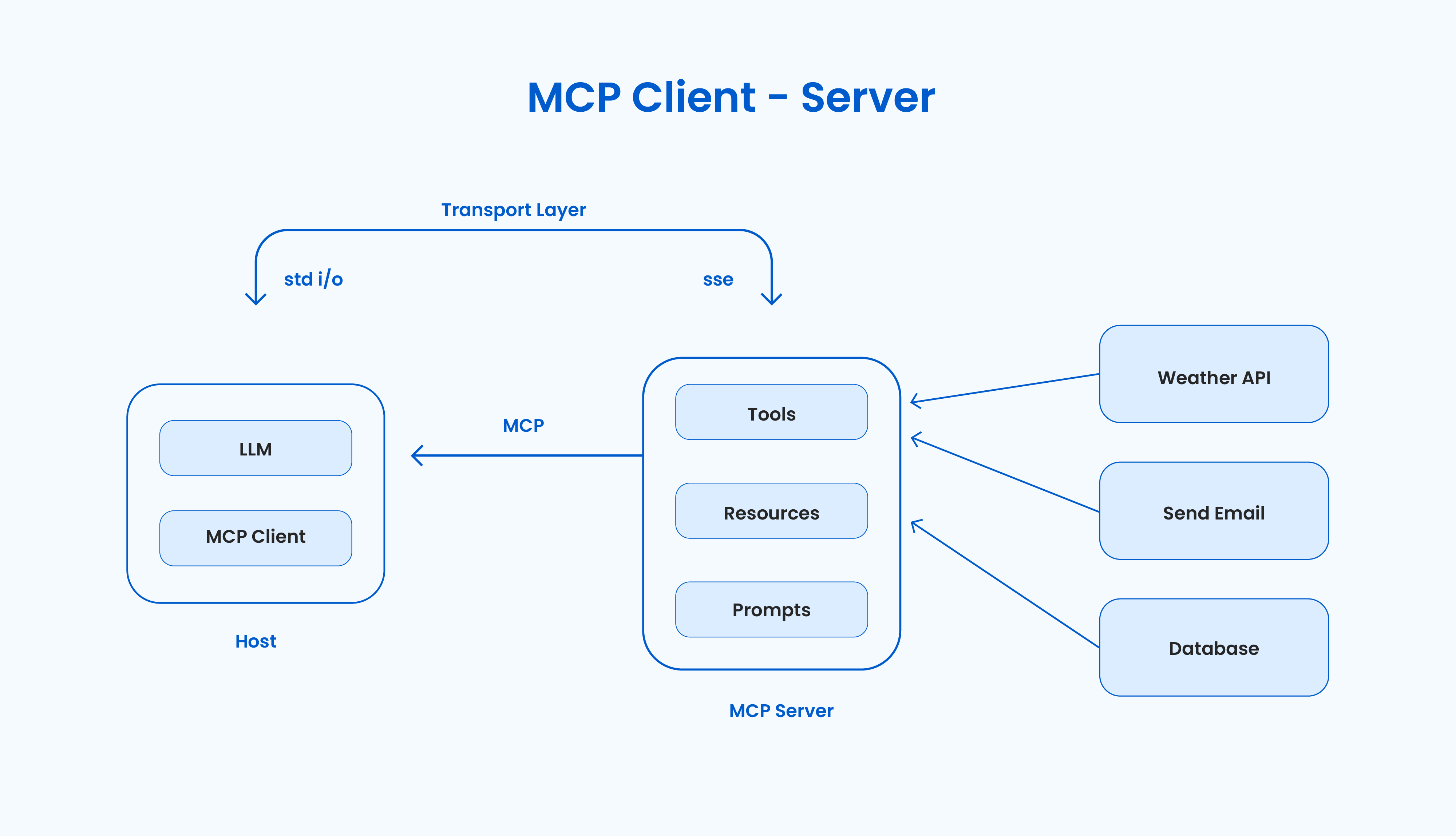
MCP is set up as a client-server architecture: an AI host, such as a chatbot or IDE assistant, runs one or more MCP clients. Each client connects to a remote MCP server. This architecture is illustrated below:
A typical MCP client-server architecture
MCP clients are lightweight modules embedded within the AI application. A client will perform a discovery handshake with the server, note its capabilities (i.e., the tools, resources, and prompts offered by the server), and forward requests (such as data queries or function calls) from the LLM to the server. When a client calls a tool, the MCP server will execute it and return the result.
An MCP server can either be configured using third-party integration (think a connector for Stripe or Google Calendar) or through internal infrastructure. This decoupling allows any MCP client to connect to any MCP server.
Applications within the MCP domain have traditionally offered users a binary choice, which means any given system could either be an MCP client or an MCP server, but never both. In a client role, an application will only initiate calls to servers without being invoked as a tool itself. In a server role, a service will only expose its capabilities (tools or resources) to clients, without being able to call other MCP servers.
However, an application can also function as both a client and a server. This dual role puts MCP at the center of complex, layered systems. We’ll examine this dual functionality and its significance in detail a little later in this blog.
MCP Server Capabilities in Astera AI
Astera AI functions as a fully capable MCP server, enabling easy integration of AI agents and services into your enterprise ecosystem. Following the MCP standard, Astera AI exposes a structured, machine-readable catalog of agents, models, and services. MCP clients can query and consume this catalog, letting organizations discover and invoke AI capabilities across their internal or partner systems.
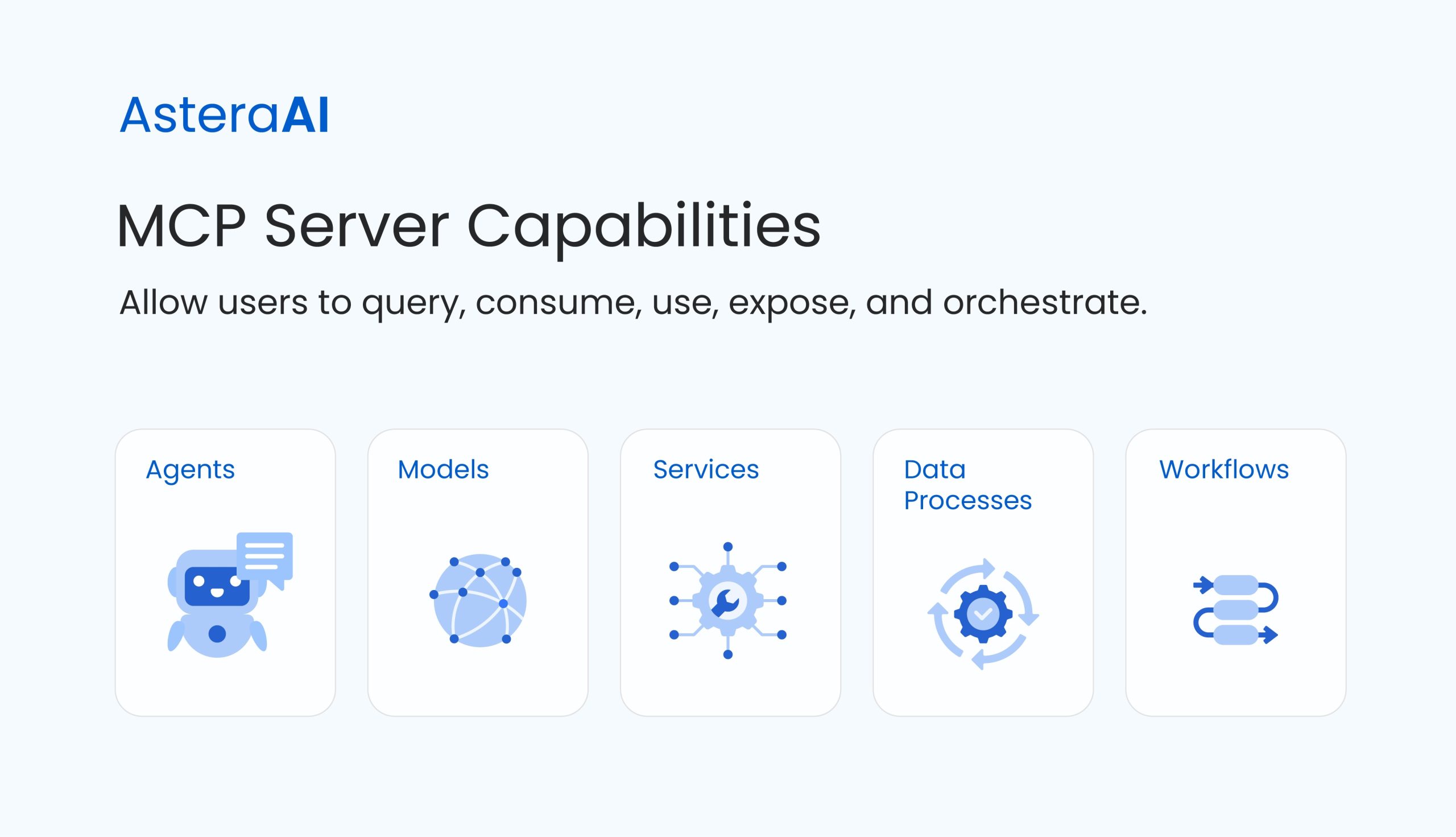
At the server level, Astera AI ensures the secure exposure of agents and services through granular access controls and authentication protocols. You can configure which teams have access to which agents, define usage permissions, and apply role-based policies to maintain strict data governance and compliance standards.
Astera’s MCP server functionality is integrated with solutions such as ReportMiner and Data Pipeline. This means our users can easily expose and orchestrate data-related MCPs, such as data transformation flows, enrichment processes, and cleansing routines. Their downstream applications can obtain high-quality, pre-processed data in real time through standardized MCP interfaces.
External systems, such as cloud platforms, ERP applications, or even custom-built solutions, can all function as MCP clients and consume Astera-hosted AI agents without having to host them locally. This lowers operational overhead for our partner organizations while also giving them consistent, secure access to AI-driven functionality.
A few real-world examples of Astera AI’s MCP server functionality include automated invoice processing in AP systems, streamlining customer data enrichment for CRM platforms, and powering intent recognition engines in contact center software.
MCP Client Capabilities in Astera AI
Astera AI also functions effectively as an MCP client. This means that the AI agents developed using Astera AI can readily interact with external, MCP-compliant servers to request models, consume services, retrieve results, and initiate workflows without hardcoded individual integrations.
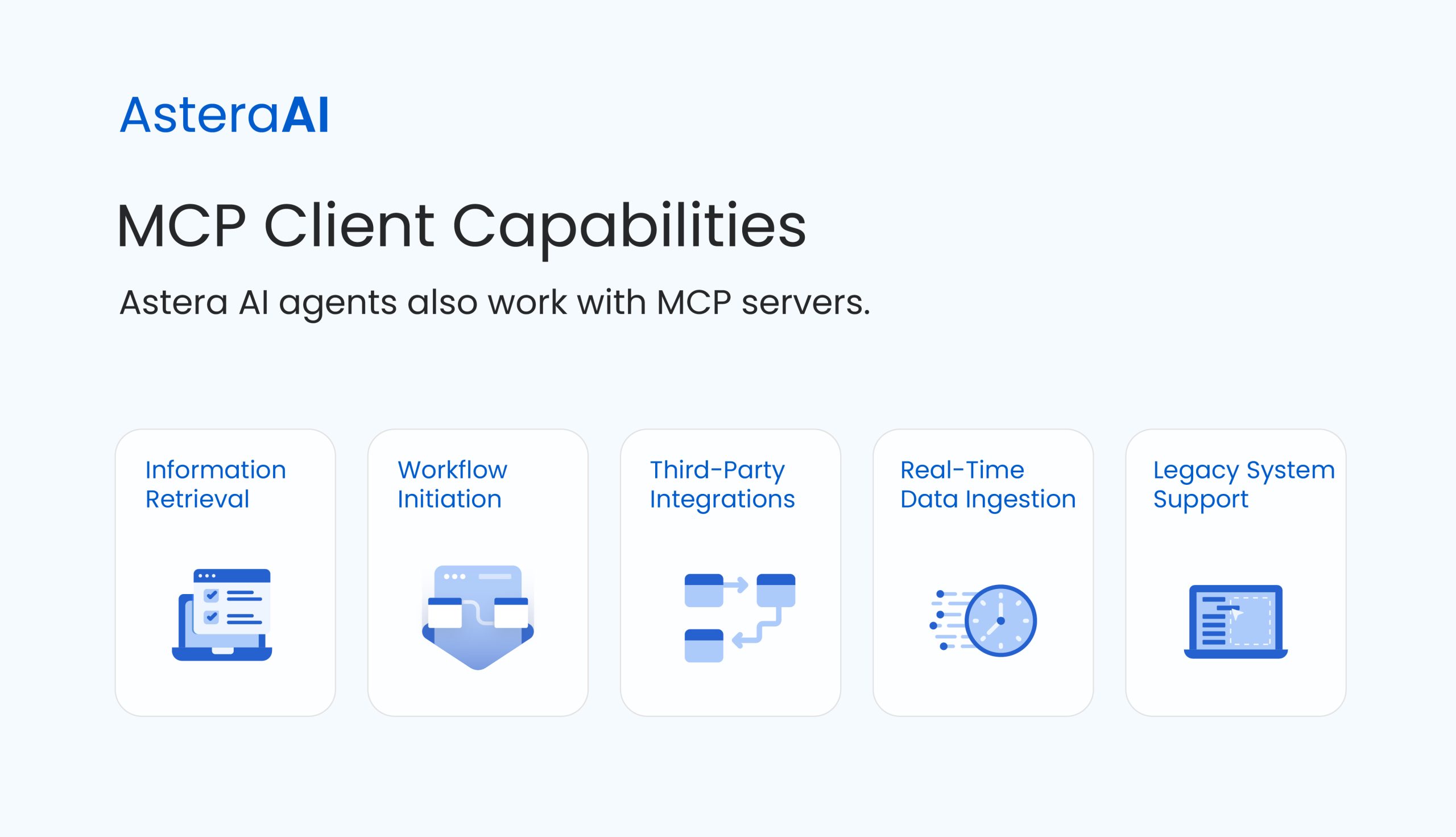
These client capabilities support integration with third-party data sources and business applications such as ERPs, CRMs, and cloud data warehouses, enabling MCP agents to ingest contextual data in real time. Moreover, agents can also invoke legacy systems, APIs, or proprietary tools that you’ve already deployed within your organization, making them interoperable with a modern agentic AI ecosystem.
Real-world use cases for MCP client functionality include supply chain agents pulling demand forecasts from external ML APIs, customer service bots fetching real-time SLA data from legacy backends, or finance agents retrieving information from credit scoring services.
The Duality of MCP and Its Importance
We’ve discussed the MCP client and server roles individually and explored how they function within Astera AI. Let’s look at the dual MCP client-server role and why it matters.
As mentioned earlier, the conventional approach for an MCP application is to work as a client or a server. This either/or approach hinders flexibility and leaves limited room for innovation and experimentation.
More importantly, MCP’s design is deliberately composable. There are no physical distinctions between an MCP client and an MCP server. The differences between the two are merely logical. Which is why an application can simultaneously manage two different kinds of connections: outbound MCP links to upstream servers and inbound MCP connections from downstream clients.
Dual MCP support lets any AI agent consume services from MCP-compliant systems while concurrently serving its own capabilities to others. This facilitates more innovative agent design, where every component — be it a data source, model, or business logic module — can be abstracted as a reusable service. This modularity makes it easy to introduce new capabilities, reuse proven models, and develop complex workflows quickly.
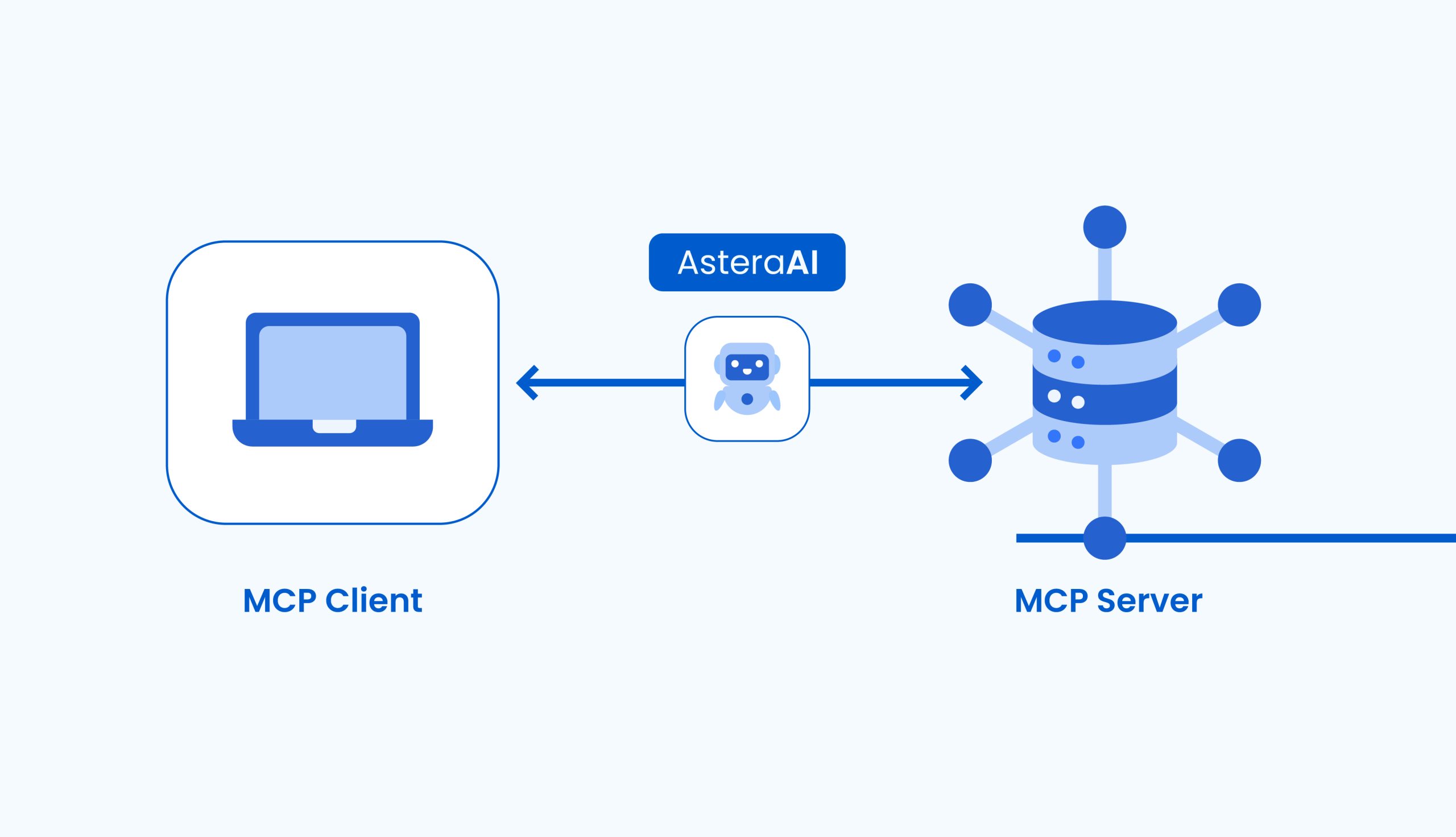
MCP server and client roles within Astera AI don’t exist or operate in isolation. Rather, they work together. For instance, an agent can act as a client by calling an external service to retrieve insights, then switch roles immediately to serve those insights to other agents. When every agent is able to both consume and serve, bidirectional communication becomes the standard, removing the need for rigid hierarchies.
In multi-agent solutions designed to serve entire departments or organizations, dual MCP support enables AI agents to align around shared objectives while retaining their autonomy. These agents can step in and out of their roles as required, keeping up with workflows as they evolve and scale.
True agent ecosystems need flexible, interoperable architectures. When you work with dual MCP functionality, you ensure that your agentic workflows are as flexible and modular as possible.
Benefits of the Joint Client-Server MCP Model
There are some specific capabilities that are only found in AI agents with dual MCP functionality, such as:
1. Composability and Modularity
Building layered agent systems is easier with dual-mode MCP. For instance, you can have a high-level ‘orchestrator’ agent (acting as a client) to delegate subtasks to specialized sub-agents (working as servers but also as clients if they require access to tools or services), then utilize these findings to drive its own logic.
2. Simpler Integration
MCP’s standardized interface frees developers from building custom connectors for each pair of systems. Instead, new tools or data services only need to be exposed as an MCP server once for any agent to act as a client and use them. By that same principle, an agent’s own capabilities also need to be exposed only once as an MCP server to make them ready for use by clients.
3. Runtime Discovery
MCP supports runtime discovery of capabilities, enabling dual-role agents to dynamically find and plug into new servers while also offering new tools to others. This makes it easier to bring in new tools or data sources without altering the agent’s code, with MCP compliance being the only factor.
The Dual MCP Functionality in Action: Data Operations Through a Chat-Based UI
Astera AI’s dual MCP functionality makes it possible to perform complex data-related tasks — including data preparation, cleaning, extraction, or data warehousing — entirely through a chat-based interface without even using Astera’s drag-and-drop functionality.
Several mechanisms and features come together to bring this use case to life.
1. Conversational Agents with Structured Input and Output
The platform supports AI agents that can interact with users using structured input and output message formats. These agents can parse incoming user requests submitted through the chat interface (for example: “Clean missing values in customer data”), then convert them into standardized instructions that can trigger predefined logic flows.
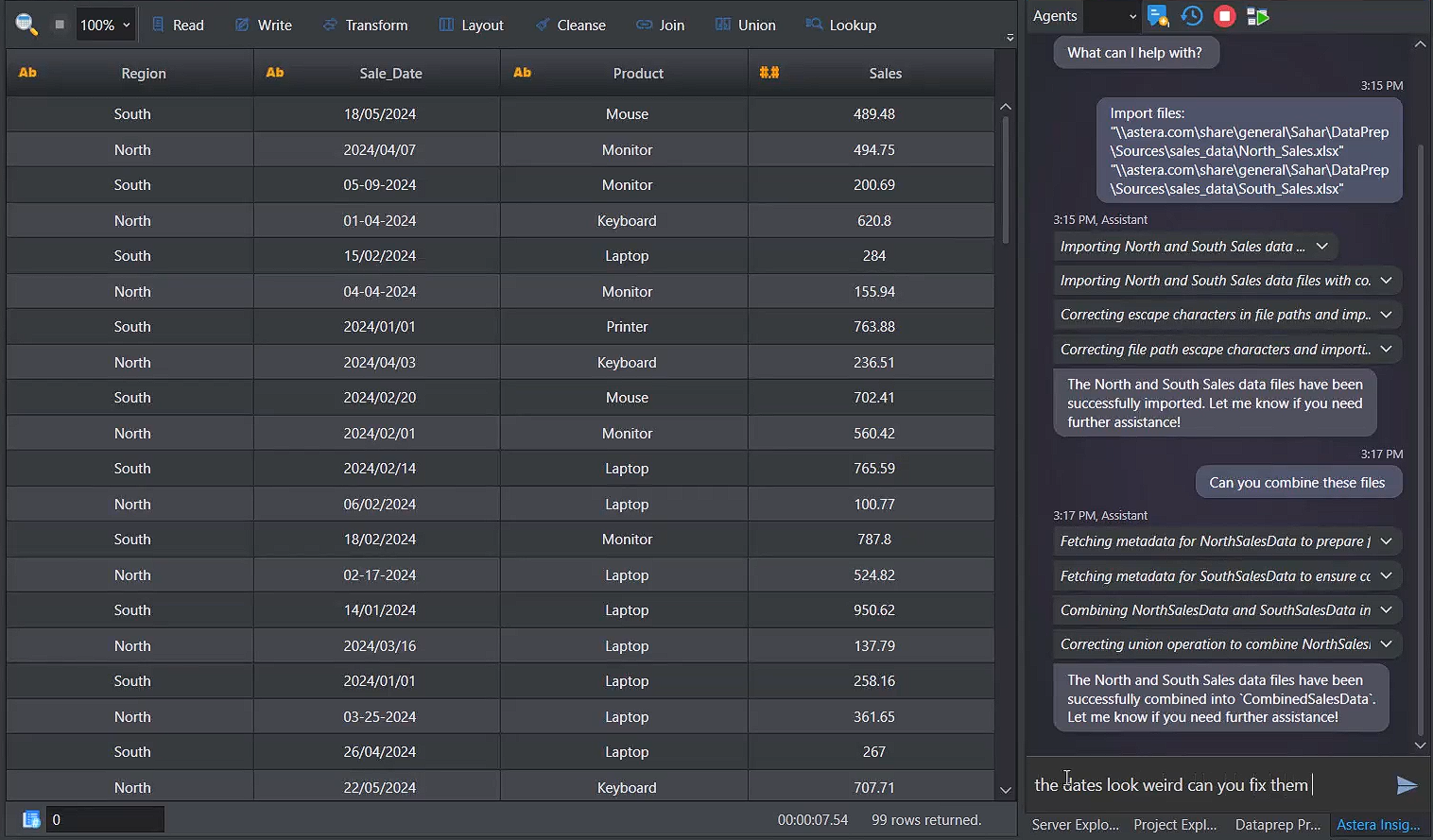
Data cleaning using natural language instructions through Astera AI’s chat-based interface
2. Exposing Backend Data Tasks or Triggering External Services
Dataflows, ETL pipelines, transformations, and logic built on the Astera platform can be published as MCP server endpoints. These endpoints are callable by Astera AI’s chat-based agents. A user can request a task conversationally using simple English-language instructions, and the agent will call the appropriate data operation exactly as if it were dragged and dropped from the platform’s built-in objects.
A chat-based agent can also act as an MCP client to, for instance, query a database. So even if a particular data task isn’t hosted locally, the agent will still be able to complete it by reaching out to another MCP-compatible service.
3. Built-in Access to Data Functions
Astera agents can directly access built-in capabilities such as data transformations, profiling, and quality checks, without user intervention. An agent can invoke these native tools in response to chat inputs, since it understands which function to trigger based on the user’s natural language inputs.
4. Prompt Engineering with Real-Time Data Injection
Astera AI supports structured prompt templates that dynamically inject data from sources such as CRMs or ERPs into agent prompts. This feature enables chat-based agents to intelligently retrieve, transform, or summarize data according to real-time enterprise context. These agents can also conversationally automate data extraction or preparation tasks.
Together, these features transform the chat UI into a front-end to the entire Astera Data Stack. All capabilities usable through workflows become callable via an agent, as long as they’re appropriately published or exposed, and enterprise data orchestration becomes conversational.
Dual MCP support is central to this entire use case. As an MCP client, a chat-based agent can initiate actions such as calling an ETL pipeline, cleansing a dataset, or pulling CRM data. As an MCP server, the same agent can share its results and capabilities with other agents or systems, making its work triggerable and usable by others.
Without dual MCP, an agent would only be able to do half the job, decreasing its value in enterprise data automation.
Build Scalable AI Agents—Faster, Smarter, and Without the Guesswork
Want AI agents without weeks of coding or complex setup? Skip the technical hurdles. Astera AI Agent Builder gives you a drag-and-drop interface, powerful integrations, and enterprise-ready performance. No data science degree required.
Learn More
Summing It Up
It’s not inaccurate to say that MCP is the “giant leap forward” for ensuring interoperable, standardized communications between AI agents and the systems and services they must work with.
However, with agentic automation gaining popularity across industries, dual MCP functionality offers more than just an elegant, logical way forward for building more capable and communicative AI agents.
It’s an exciting, flexible approach that lowers the need for middleware, promotes bidirectional coordination, and turns every agent into a self-contained microservice that can be reused, extended, or fit into larger organizational workflows. This flexibility is necessary for scalable, maintainable, and intelligent enterprise automation.
Embracing dual MCP functionality means prioritizing composability, interoperability, and agent-based thinking. Giving these factors their due importance can prepare organizations for next-generation enterprise AI success.
Ready to build dual-MCP agents for your business? Learn more about Astera AI Agent Builder.
It’s true that we’re already seeing AI agents implemented in functions such as customer support and marketing. But what if we could do the same for data management? What if we could automate and simplify a range of data tasks using AI agents and natural language prompts? Specialized, autonomous AI agents hold the potential to transform data management from a reactive and largely manual process into an intelligent, self-governing system, i.e., an agentic data stack.
This blog introduces Astera AI, an agentic data management platform that can perform data management functions with simple user inputs.
The Enterprise Case for Agentic Data Management
AI has had an undeniable impact on intensive tasks that were previously deemed too difficult to automate. Take coding, for instance. Research shows that AI assistance leads to 55% faster task completion and 78% higher success rates. Plus, domain-specific AI assistance can reduce or even eliminate the technical barrier, as evident by the fact that a quarter of the startups in YC’s Winter 2025 batch had 95% AI-generated codebases.
In order to extract the full value of enterprise data, companies need to overcome certain challenges that general AI can not solve. For instance, data silos cost the global economy upwards of $3.1 trillion every year.
Moreover, organizations lose nearly 1/3rd of their productivity to employees chasing data across disconnected systems. Addressing these challenges requires an approach based on a deep understanding of each company’s unique data architecture, integration patterns, and business workflows.
Enterprise data management needs a similar revolution, i.e., its own agentic framework that understands the unique complexities of the enterprise data landscape. Such a platform would position data teams to perform complex data management tasks just by using simple natural language prompts. Let’s look at what that would look like across the different domains of data integration, data warehousing, unstructured data management, data prep, and analytics.
Agentic AI for Data Integration and Warehousing
Astera’s agentic data management platform combines specialized AI with comprehensive data management capabilities. Because it’s uniquely built for data management, our platform comes equipped with a unique understanding of data integration patterns, quality requirements, and governance frameworks. This allows us to go beyond generic automation to help enterprises achieve specialized agentic automation and intelligence.
More importantly, it’s a platform designed specifically for enterprise data, which means every module, every component, and every feature has been built to address a real-life use case. But what’s different from Astera’s previous offerings, and how does AI factor into it all? Astera’s vision of a no-code platform has led us to a solution that lets users build ETL pipelines and perform data modeling using simple, natural language prompts.
Agentic Workflow for Integration and Warehousing Tasks
Astera is leveraging agentic AI so that users only have to state their requirements in plain English, and our agentic platform handles the rest. With Astera, data teams can perform data management tasks using a chat-based interface—no coding experience required. This is achieved by replacing rule-based ETL pipelines with specialized agents to create end-to-end automation loops. These agents do more than just follow the rules, working in a collaborative environment to gain a contextual understanding of your enterprise data.
For example, here’s how a specialized agent for data integration works:
- An Orchestrator workflow that continuously monitors data sources (databases, APIs, data streams, IoT feeds, etc.) and schedules batch and real-time ingestion jobs.
- Specialist workflows are triggered to perform context-aware transformations once the data comes in. These agents extract data fields, normalize formats, enrich records, and detect anomalies on the go.
- A Trust workflow then enforces data quality by validating entries, deduplicating, and reconciling discrepancies to ensure the data is clean and compliant.
- At the same time, an Ops workflow observes query performance and system health, recommending new indexes and caching strategies, balancing workloads, and auto-tuning the databases for the current workload.
The system can also include Metadata and Catalog workflows to update data catalogs and metadata in real-time and attach business context and lineage to data fields to make data discoverable and data integration self-governing.
Think of the entire system as an AI-driven conveyor belt that not only moves data but continuously inspects, adjusts, and improves its performance without human intervention. Users only have to prompt the system to perform specific tasks using natural language, while the rest of the heavy lifting is automated using agentic AI.
Agentic AI for Data Prep and Analytics
Data prep tasks can take up 80% of a data scientist’s productivity. Agentic AI can fundamentally transform this by enabling autonomous, intelligent data preparation workflows. Astera’s approach to data prep combines a chat-based interface with AI-driven automation to turn tedious and complex data preparation tasks into simple, natural language interactions.
Astera Data Prep lets users describe data preparation tasks in plain language and have the system intelligently apply the appropriate transformations automatically. Users can simply type commands like “filter out records where contact title is ‘Sales Manager'” or “calculate the average revenue by region,” and the AI agent interprets the intent and executes the required operations autonomously.
This conversational approach democratizes data preparation by reducing the need for technical expertise in SQL, scripting, or complex transformation logic. The AI agent understands business context, data relationships, and transformation requirements, translating natural language descriptions into precise data operations. This dramatically reduces the learning curve and accelerates data preparation workflows from hours to minutes.
The AI agent learns from interaction patterns to suggest optimizations, identify potential data quality issues, and recommend additional transformations based on the current dataset characteristics. This creates an intelligent feedback loop where the system becomes more effective at anticipating user needs and proactively suggesting data improvements.
Visual Recipe-Driven Agentic Workflows
Astera Data Prep’s Recipe Actions framework enables agentic workflows through visual, reusable data preparation sequences that can be automatically generated, modified, and optimized. The system maintains a comprehensive catalog of transformation patterns such as Join, Union, Lookup, Calculation, Aggregation, Filter, Sort, and Distinct operations. These can be intelligently combined to address complex data preparation requirements of enterprises and individual users alike.
The visual recipe approach enables autonomous workflow optimization as the system can analyze transformation sequences, identify inefficiencies, and suggest improvements. For example, if multiple filter operations are applied sequentially, the system can automatically combine them into a single, more efficient operation while maintaining the same logical outcome.
Recipe versioning and lineage tracking create audit trails that enable the system to learn from successful patterns and automatically apply them to similar datasets. This builds organizational knowledge that improves data preparation efficiency over time while ensuring consistency across projects.
Autonomous Data Quality Management
Real-time active profiling continuously monitors data health through automated assessment of cleanliness, uniqueness, and completeness metrics. Astera’s Profile Browser provides comprehensive data insights through dynamic graphs, charts, and field-level analysis that updates automatically as transformations are applied, enabling immediate feedback on data quality improvements.
Data quality agents operate autonomously to detect anomalies, inconsistencies, and potential issues before they impact downstream processes. These agents understand statistical baselines for different data types and can identify outliers, missing value patterns, and data distribution changes that might indicate quality problems.
Automated data validation rules can be applied dynamically based on data characteristics and business requirements. The system learns from user corrections and quality assessments to improve its ability to identify and flag potential issues proactively, reducing the manual effort required for data quality assurance.
Integrated Analytics and Preview-Driven Insights
The preview-centric grid interface provides Excel-like familiarity while delivering real-time feedback on data transformations. This interactive environment enables users to see the immediate impact of changes, making data preparation more intuitive and reducing the risk of errors that often occur in traditional batch processing approaches.
Integrated analytics capabilities allow the system to automatically generate insights and recommendations based on data patterns observed during preparation. As users clean and transform data, the system can identify trends, correlations, and anomalies that might be relevant for subsequent analysis, turning data preparation into an exploratory process.
The centralized Data Source Browser enables agentic data discovery by automatically cataloging available data sources and suggesting relevant datasets based on current preparation tasks. This reduces the time spent searching for appropriate data and ensures that users have access to the most comprehensive datasets for their analysis needs.
Adaptive Learning and Optimization
Astera Data Prep continuously learn from user interactions, successful transformation patterns, and data quality outcomes to improve its performance over time. The system builds organizational knowledge about effective data preparation techniques, common data quality issues, and optimal transformation sequences for different types of datasets.
Performance optimization occurs automatically as the system identifies bottlenecks in data preparation workflows and suggests more efficient approaches. This includes recommending optimal transformation sequences, identifying opportunities for parallel processing, and suggesting data sampling strategies for large datasets.
The platform’s ability to handle diverse data sources seamlessly, from file sources to catalog sources to project sources, enables agentic data integration where the system can automatically identify and resolve schema differences, data format inconsistencies, and integration challenges without manual intervention.
Astera’s Vision For An Agentic Data Stack
Astera’s vision for a unified agentic data stack includes a multi-agent system comprising specialized agents to perform tasks related to data integration, warehousing, and preparation. With a simple chat interface at the front, users will be able to ingest, transform, integrate, and load their data using natural language prompts.
Depending on the user’s request, the chatbot will be able to trigger specialized agents to perform tasks, execute workflows, and seamlessly connect to internal and external sources. The end result? A data stack that can be run by domain experts and specialists without technical expertise, just by using simple prompts.
Ready to embrace the future of data management?
Astera is all set to revolutionize how enterprises manage their data. From automated data extraction to chat-based data-prep. Astera combines agentic AI with our award-winning data management suite to deliver a novel agentic data stack.
Connect with us to learn more.

Jay Mishra
Astera’s Chief Product and Technology Officer- Jay Mishra, is a seasoned data architect and software solutions expert with over two decades of experience. With a deep expertise in product development, Jay has played a pivotal role in transforming organizations by delivering advanced, AI-powered data solutions. His leadership has been instrumental in providing scalable, user-friendly platforms that address complex data challenges for enterprises, ensuring seamless operations and successful outcomes.
With the rapidly evolving financial landscape, intelligent automation is no longer optional- it’s essential. Traditional automation tools and chatbots fall short in delivering intelligent, contextual support.
This is where AI Agents come in. These autonomous, task-oriented assistants are designed to handle complex workflows across banking, fintech, and insurance. From automating routine queries to enhancing fraud detection and compliance, AI Agents are transforming the way financial institutions operate.
Building personalized AI agents typically demands deep technical expertise and significant time and resources. But Astera AI Agent Builder is here to change that!
With a user-friendly visual interface, it empowers teams to quickly build, test, and deploy intelligent agents that seamlessly integrate with enterprise systems- no engineering heavy-lift or long development cycles required.
Join us on 18th June 2025 at 11 AM PT for a LinkedIn Live session with our technical experts, and discover how AI agents can automate financial workflows for you!
In this session, you will learn how to:
 Build and test financial AI agents using a visual drag-and-drop designer
Connect AI agents directly to your financial data sources.
Experiment, iterate, and deploy agents securely at scale
Empower your data and business teams to drive AI adoption
Reserve your spot today and explore how Astera AI Agent Builder can help you automate financial workflows with AI—on your terms.
Ayesha Amjad
Ayesha Amjad, spearheads Astera's AI strategy. With 5+ years in the field, Ayesha has honed a diverse skill set, successfully launching enterprise-grade products, including Astera's inaugural AI-integrated feature. An expert in unstructured data management, AI, and data science, she provides consultancy to Fortune 500 companies and small to medium businesses on complex data use-cases, while also mentoring up-and-coming APMs.