

An agentic data stack is a data management environment where specialized AI agents, directed through natural language prompts, perform tasks such as data integration, data warehousing, and data preparation. Agentic data management uses these autonomous agents to handle data tasks that were once largely manual.
As enterprise data grows in volume, variety, and velocity, the need for a new approach to data architecture is becoming clearer. As AI evolves from generative to agentic, can enterprises also adopt an agentic data architecture?
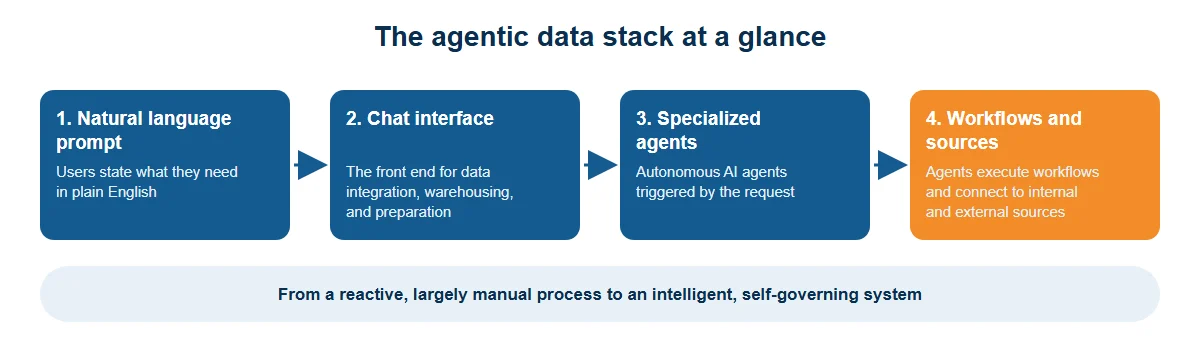
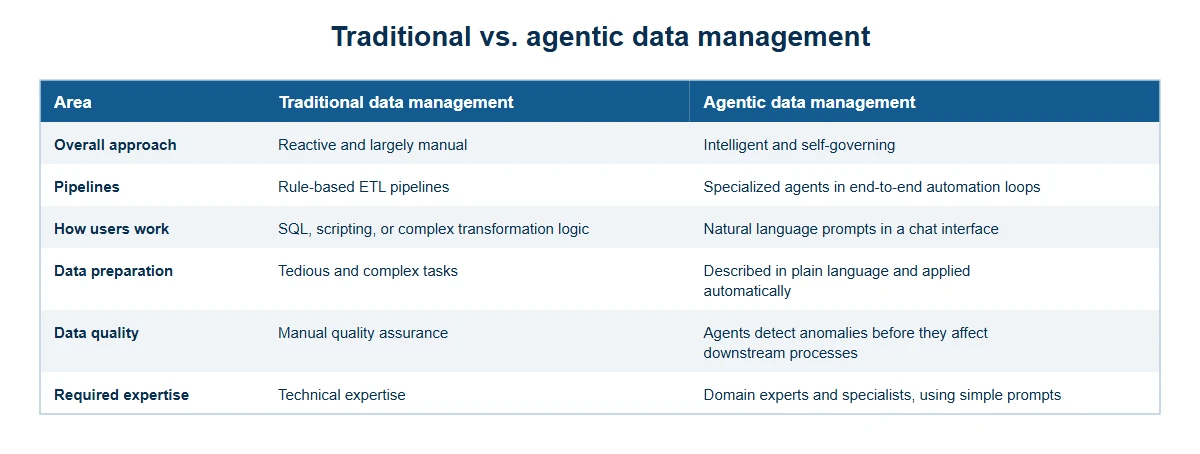
We're already seeing AI agents used for functions such as customer support and marketing. But what if the same approach could be applied to data management? AI agents guided by natural language prompts could automate and simplify a range of data tasks, helping transform data management from a reactive, largely manual process into a more intelligent and autonomous system: an agentic data stack.
This blog introduces Astera AI, an agentic data management platform that enables users to perform data management tasks using simple natural language inputs.
The Enterprise Case for Agentic Data Management
AI has had an undeniable impact on intensive tasks that were previously deemed too difficult to automate. Take coding, for instance. Research shows that AI assistance leads to 55% faster task completion and 78% higher success rates. Plus, domain-specific AI assistance can reduce or even eliminate the technical barrier, as evident by the fact that a quarter of the startups in YC's Winter 2025 batch had 95% AI-generated codebases.
The Cost of Disconnected Data
In order to extract the full value of enterprise data, companies need to overcome certain challenges that general AI can not solve. For instance, data silos cost the global economy upwards of $3.1 trillion every year.
Moreover, organizations lose nearly 1/3 rd of their productivity to employees chasing data across disconnected systems. Addressing these challenges requires an approach based on a deep understanding of each company's unique data architecture, integration patterns, and business workflows.
Why Data Management Needs Its Own Agentic Framework
Enterprise data management needs a similar revolution, i.e., its own agentic framework that understands the unique complexities of the enterprise data landscape. Such a platform would position data teams to perform complex data management tasks just by using simple natural language prompts. Let's look at what that would look like across the different domains of data integration, data warehousing, unstructured data management, data P&P, and analytics.
Agentic AI for Data Integration and Warehousing
Astera's agentic data management platform combines specialized AI with comprehensive data management capabilities. Because it's uniquely built for data management, our platform comes equipped with a unique understanding of data integration patterns, quality requirements, and governance frameworks. This allows us to go beyond generic automation to help enterprises achieve specialized agentic automation and intelligence.
More importantly, it's a platform designed specifically for enterprise data, which means every module, every component, and every feature has been built to address a real-life use case. But what's different from Astera's previous offerings, and how does AI factor into it all? Astera's vision of a no-code platform has led us to a solution that lets users build ETL pipelines and perform data modeling using simple, natural language prompts.
Agentic Workflow for Integration and Warehousing Tasks
Astera is leveraging agentic AI so that users only have to state their requirements in plain English, and our agentic platform handles the rest. With Astera, data teams can perform data management tasks using a chat-based interface—no coding experience required. This is achieved by replacing rule-based ETL pipelines with specialized agents to create end-to-end automation loops. These agents do more than just follow the rules, working in a collaborative environment to gain a contextual understanding of your enterprise data.
For example, here's how a specialized agent for data integration works:
An Orchestrator workflow that continuously monitors data sources (databases, APIs, data streams, IoT feeds, etc.) and schedules batch and real-time ingestion jobs.
Specialist workflows are triggered to perform context-aware transformations once the data comes in. These agents extract data fields, normalize formats, enrich records, and detect anomalies on the go.
A Trust workflow then enforces data quality by validating entries, deduplicating, and reconciling discrepancies to ensure the data is clean and compliant.
At the same time, an Ops workflow observes query performance and system health, recommending new indexes and caching strategies, balancing workloads, and auto-tuning the databases for the current workload.
The system can also include Metadata and Catalog workflows to update data catalogs and metadata in real-time and attach business context and lineage to data fields to make data discoverable and data integration self-governing.
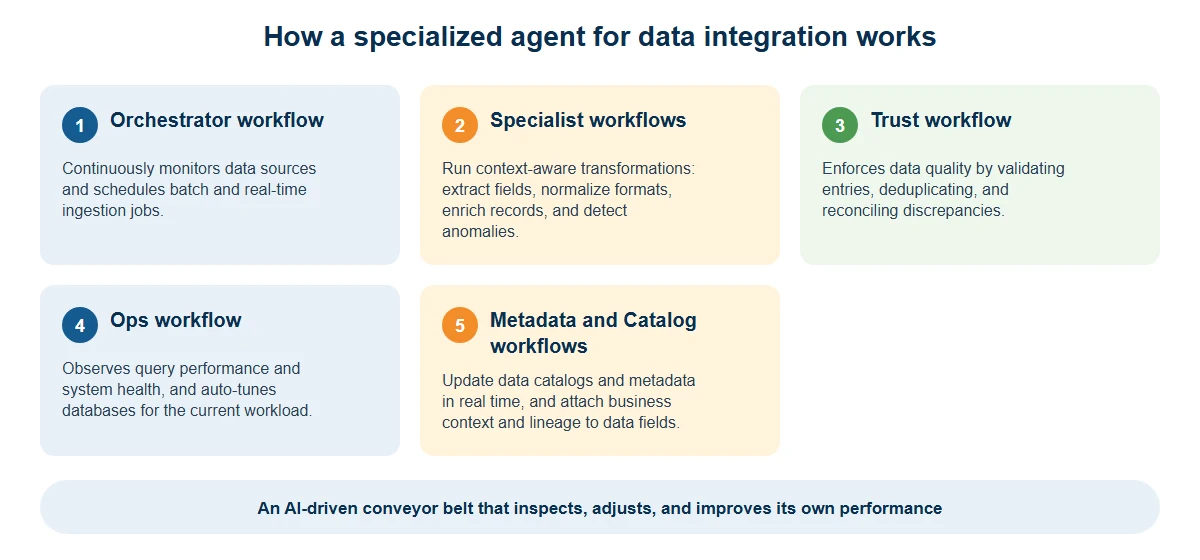
Think of the entire system as an AI-driven conveyor belt that not only moves data but continuously inspects, adjusts, and improves its performance without human intervention. Users only have to prompt the system to perform specific tasks using natural language, while the rest of the heavy lifting is automated using agentic AI.
Build Scalable AI Agents—Faster, Smarter, and Without the Guesswork
Want AI agents without weeks of coding or complex setup? Skip the technical hurdles. Astera AI Agent Builder gives you a drag-and-drop interface, powerful integrations, and enterprise-ready performance. No data science degree required.
Agentic AI for Data Prep and Analytics
Data prep tasks can take up 80% of a data scientist's productivity. Agentic AI can fundamentally transform this by enabling autonomous, intelligent data preparation workflows. Astera's approach to data prep combines a chat-based interface with AI-driven automation to turn tedious and complex data preparation tasks into simple, natural language interactions.
Chat-Based Data Preparation in Plain Language
Astera Data Prep lets users describe data preparation tasks in plain language and have the system intelligently apply the appropriate transformations automatically. Users can simply type commands like "filter out records where contact title is 'Sales Manager'" or "calculate the average revenue by region," and the AI agent interprets the intent and executes the required operations autonomously.
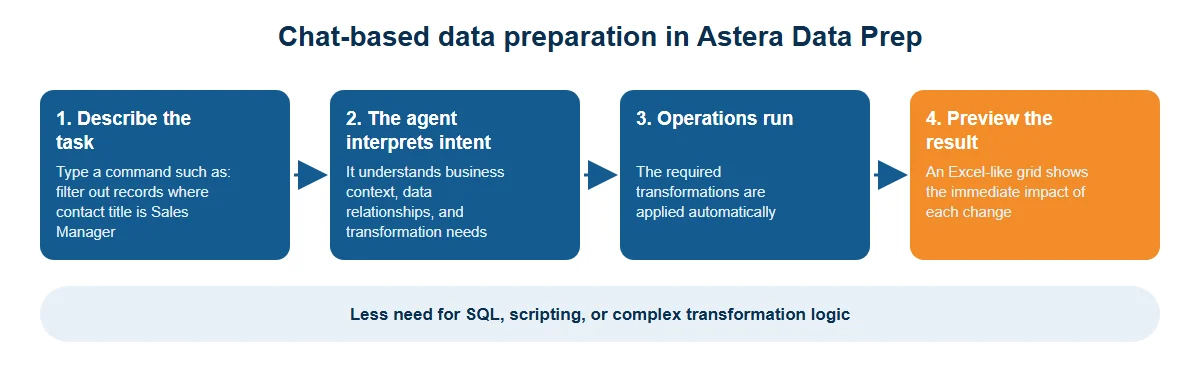
This conversational approach democratizes data preparation by reducing the need for technical expertise in SQL, scripting, or complex transformation logic. The AI agent understands business context, data relationships, and transformation requirements, translating natural language descriptions into precise data operations. This dramatically reduces the learning curve and accelerates data preparation workflows from hours to minutes.
The AI agent learns from interaction patterns to suggest optimizations, identify potential data quality issues, and recommend additional transformations based on the current dataset characteristics. This creates an intelligent feedback loop where the system becomes more effective at anticipating user needs and proactively suggesting data improvements.
Visual Recipe-Driven Agentic Workflows
Astera Data Prep's Recipe Actions framework enables agentic workflows through visual, reusable data preparation sequences that can be automatically generated, modified, and optimized. The system maintains a comprehensive catalog of transformation patterns such as Join, Union, Lookup, Calculation, Aggregation, Filter, Sort, and Distinct operations. These can be intelligently combined to address complex data preparation requirements of enterprises and individual users alike.
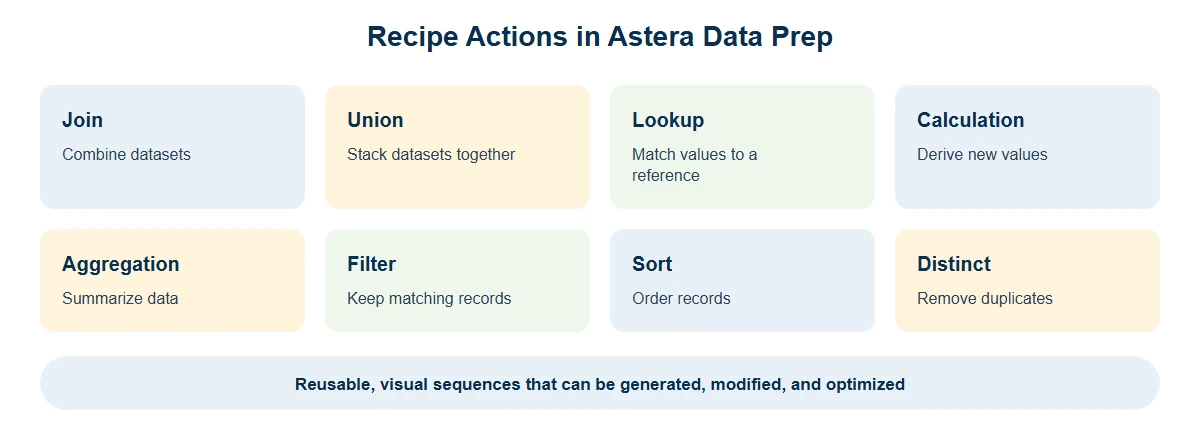
The visual recipe approach enables autonomous workflow optimization as the system can analyze transformation sequences, identify inefficiencies, and suggest improvements. For example, if multiple filter operations are applied sequentially, the system can automatically combine them into a single, more efficient operation while maintaining the same logical outcome.
Recipe versioning and lineage tracking create audit trails that enable the system to learn from successful patterns and automatically apply them to similar datasets. This builds organizational knowledge that improves data preparation efficiency over time while ensuring consistency across projects.
Autonomous Data Quality Management
Real-time active profiling continuously monitors data health through automated assessment of cleanliness, uniqueness, and completeness metrics. Astera’s Profile Browser provides comprehensive data insights through dynamic graphs, charts, and field-level analysis that updates automatically as transformations are applied, enabling immediate feedback on data quality improvements.
Data quality agents operate autonomously to detect anomalies, inconsistencies, and potential issues before they impact downstream processes. These agents understand statistical baselines for different data types and can identify outliers, missing value patterns, and data distribution changes that might indicate quality problems.
Automated data validation rules can be applied dynamically based on data characteristics and business requirements. The system learns from user corrections and quality assessments to improve its ability to identify and flag potential issues proactively, reducing the manual effort required for data quality assurance.
Integrated Analytics and Preview-Driven Insights
The preview-centric grid interface provides Excel-like familiarity while delivering real-time feedback on data transformations. This interactive environment enables users to see the immediate impact of changes, making data preparation more intuitive and reducing the risk of errors that often occur in traditional batch processing approaches.
Integrated analytics capabilities allow the system to automatically generate insights and recommendations based on data patterns observed during preparation. As users clean and transform data, the system can identify trends, correlations, and anomalies that might be relevant for subsequent analysis, turning data preparation into an exploratory process.
The centralized Data Source Browser enables agentic data discovery by automatically cataloging available data sources and suggesting relevant datasets based on current preparation tasks. This reduces the time spent searching for appropriate data and ensures that users have access to the most comprehensive datasets for their analysis needs.
Adaptive Learning and Optimization
Astera Data Prep continuously learn from user interactions, successful transformation patterns, and data quality outcomes to improve its performance over time. The system builds organizational knowledge about effective data preparation techniques, common data quality issues, and optimal transformation sequences for different types of datasets.
Performance optimization occurs automatically as the system identifies bottlenecks in data preparation workflows and suggests more efficient approaches. This includes recommending optimal transformation sequences, identifying opportunities for parallel processing, and suggesting data sampling strategies for large datasets.
The platform’s ability to handle diverse data sources seamlessly, from file sources to catalog sources to project sources, enables agentic data integration where the system can automatically identify and resolve schema differences, data format inconsistencies, and integration challenges without manual intervention.
Astera’s Vision For An Agentic Data Stack
Astera’s vision for a unified agentic data stack includes a multi-agent system comprising specialized agents to perform tasks related to data integration, warehousing, and preparation. With a simple chat interface at the front, users will be able to ingest, transform, integrate, and load their data using natural language prompts.
Depending on the user’s request, the chatbot will be able to trigger specialized agents to perform tasks, execute workflows, and seamlessly connect to internal and external sources. The end result? A data stack that can be run by domain experts and specialists without technical expertise, just by using simple prompts.
Ready to embrace the future of data management?
Astera is all set to revolutionize how enterprises manage their data. From automated data extraction to chat-based data-prep. Astera combines agentic AI with our award-winning data management suite to deliver a novel agentic data stack.