
Analysis-Ready Data, Transformed Faster with AI
Apply 200+ built-in transformations in a no-code designer. AI agents draft the logic from plain-language instructions. Data quality rules validate every record before it loads.
Design, validate and deploy data transformations in one workflow
Replace hand-written SQL, scripts and separate cleansing tools. AI agents draft the transformation logic, your team validates it, and the Centerprise server executes it.
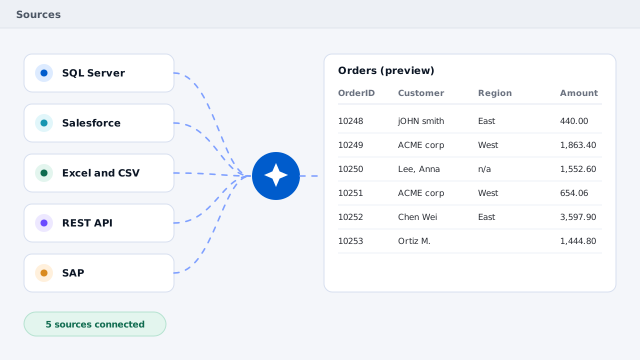
Step 1 of 5: Connect your sources
See AI-powered data transformation in action
Data transformation capabilities in one unified platform
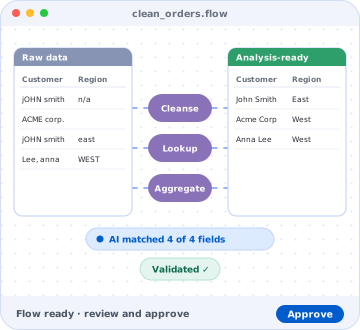
AI auto-mapper and AI lookup
Semantic profiling proposes source-to-target matches. Review and override in the visual mapper.
Natural-language AI prompts
Describe the logic in plain language and AI agents draft the dataflow, expressions and validations for you to review and approve. Bring your own LLM provider key, or host the model yourself.
AI discovery and documentation
Automated profiling infers primary keys, foreign keys and relationships, matches entities across sources, and produces profiling reports and relationship maps for audit-ready documentation.
Record-level and set-level transformations
Choose from 200+ built-in transformations. Record-level transformations derive values with lookups, functions and expressions. Set-level transformations join, sort, route, aggregate and de-duplicate groups of records.
Expression builder
Write expressions with a function library for string, data conversion, date and time, and math and comparison logic. Use variables to reuse results, and preview output at every step.
Joins, lookups and aggregation
Inner, left outer, right outer and full outer joins on composite keys. Database, list, file and SQL statement lookups. Sum, count, min, max, average, variance and standard deviation, with group-by.
Cleansing, standardization and schema alignment
Remove whitespace, letters, digits and punctuation. Replace nulls. Find and replace with literal, extended or regex patterns. Change case, align data types and apply one expression to every field.
Routing and reshaping
Route records by rules with a default output. Switch, filter, union, merge, normalize and denormalize. Transform XML and JSON hierarchies without flattening them.
Deduplication and reconciliation
Remove duplicates on all fields or key fields. Compare two sources to find new, updated and deleted records, with survivor-value rules and side-by-side change flags.
Subflows and reusable logic
Package transformation logic as subflows and call it from any dataflow. Save cleansing and reconciliation steps as re-runnable recipes, so every team works from the same definitions.
Data quality rules, anomaly checks and scoring
Record-level rules as expressions, with errors and warnings. Anomaly checks, quality scoring and profiling statistics (minimum, maximum, count, error count), with failing records logged.
No-code pipelines with pushdown ELT
Build without code, then push eligible processing down to the database as generated SQL you can review, so data moves less. Read database and file sources in parallel partitions.
Scheduling and monitoring
Run on a schedule, on file drop, on email receipt or by API call. Monitor status, duration, records processed and error count, with email alerts.
Deployment and governance
Role-based access control, Git-based version control and lineage mapping across dataflows. Deploy on-premises, in your cloud or in a hybrid setup, so data stays in your environment.
Data transformation that your whole team can build and trust
Self-serve data transformation
Analysts describe what they need in plain-language instructions or build it in a no-code designer, without waiting on engineering or SQL and SSIS expertise.
Fewer handoffs, faster delivery
Discovery, transformation, quality checks and deployment live on one platform, and AI agents draft the logic, so requests reach production with fewer handoffs.
Reusable logic, built once
Package cleansing, lookups and business rules as subflows and recipes, then reuse them across pipelines so every team works from the same definitions.
No-code pipelines, pushdown ELT
Build without code, then push processing down to your database so transformation runs where the data lives, with less data movement and parallel reads.
Keep AI under your control
Agents only reach the data each user can access, your team approves every flow, and Astera never trains models on your content.
Predictable, upfront pricing
Pay a custom price that is fixed up front. No hidden fees, renewal terms in writing, and annual increases capped for existing licenses.
Rated and recognised by the people who use it
- G24.3/531 reviews
 4.8/513 ratings
 8.7/1055 reviews

I've found Centerprise to be one of the most comprehensive and robust data integration tools in the market. It provides an endless number of great features to address any data transformation need.
 Usability
 Performance
 Support
 Support
Pricing fixed up front. No surprises later.
Your price is custom and fixed up front. No hidden fees. Renewal terms in writing, with annual increases capped for existing licenses.
What's included
- AI-powered schema discovery and profiling
- Visual transformation designer with pushdown support
- 200+ pre-built source and destination connectors
- Rule-based data quality validation and scoring
- End-to-end data lineage and metadata catalog
- Award-winning support, onboarding and training
- Batch, CDC and streaming pipeline support
- Role-based access control and audit logging
Data transformation FAQs
Data transformation converts data from one structure or format into another so it is clean, consistent and ready for analysis. It includes mapping fields, cleansing and standardizing values, joining and enriching datasets, aggregating records and validating the result before loading it into a target such as a data warehouse. Learn more about data transformation .
A data transformation platform is software that applies mapping, cleansing, joins, aggregations and validation rules to data as it moves between systems. Modern platforms such as Centerprise AI add no-code design and AI that drafts the transformation logic for you.
AI profiles your sources, infers keys and relationships, matches fields by meaning, and drafts mappings, expressions, cleansing and validation from a plain-language request. Your team reviews and approves every generated flow before it deploys.
Yes. You build transformations in a drag-and-drop designer, or describe them in plain language and let the copilot draft them. Analysts can build and change joins, lookups, cleansing and aggregations without writing SQL, while engineers can add custom expressions and custom SQL when they need advanced logic.
200+ built-in transformations. Record-level transformations (lookups, functions and expressions) derive values from a single record. Set-level transformations (join, sort, route, distinct, aggregate, union, merge, normalize, denormalize and reconcile) work on groups of records. Tree transformations handle XML and JSON hierarchies, and Data Cleanse covers whitespace, case, nulls and regex find and replace.
Yes. You build no-code pipelines, and with pushdown optimization eligible dataflow processing runs inside the database using generated SQL you can review, which reduces data movement. The source and target databases must be on the same server, and you verify the job first. Database and file sources can also be read in parallel partitions.
You write record-level rules as expressions and attach them to a field or to all mapped fields. Failing records are marked as errors or warnings, kept out of targets and logged, so problems are caught before loading. Data profile and field profile objects add statistics such as minimum, maximum, count and error count.
Still have questions?
Book a demo