
From a Data Model to a Data Warehouse, Built Faster with AI
Model dimensional and Data Vault schemas visually or in plain language. Centerprise AI generates the DDL and the fact, dimension and SCD load pipelines, then keeps them current with CDC.
Design, load and run your data warehouse in one workflow
Bring schema design, pipeline building and scheduling into one place. AI agents draft the model and the pipelines, your team approves them, and the Centerprise server runs them.
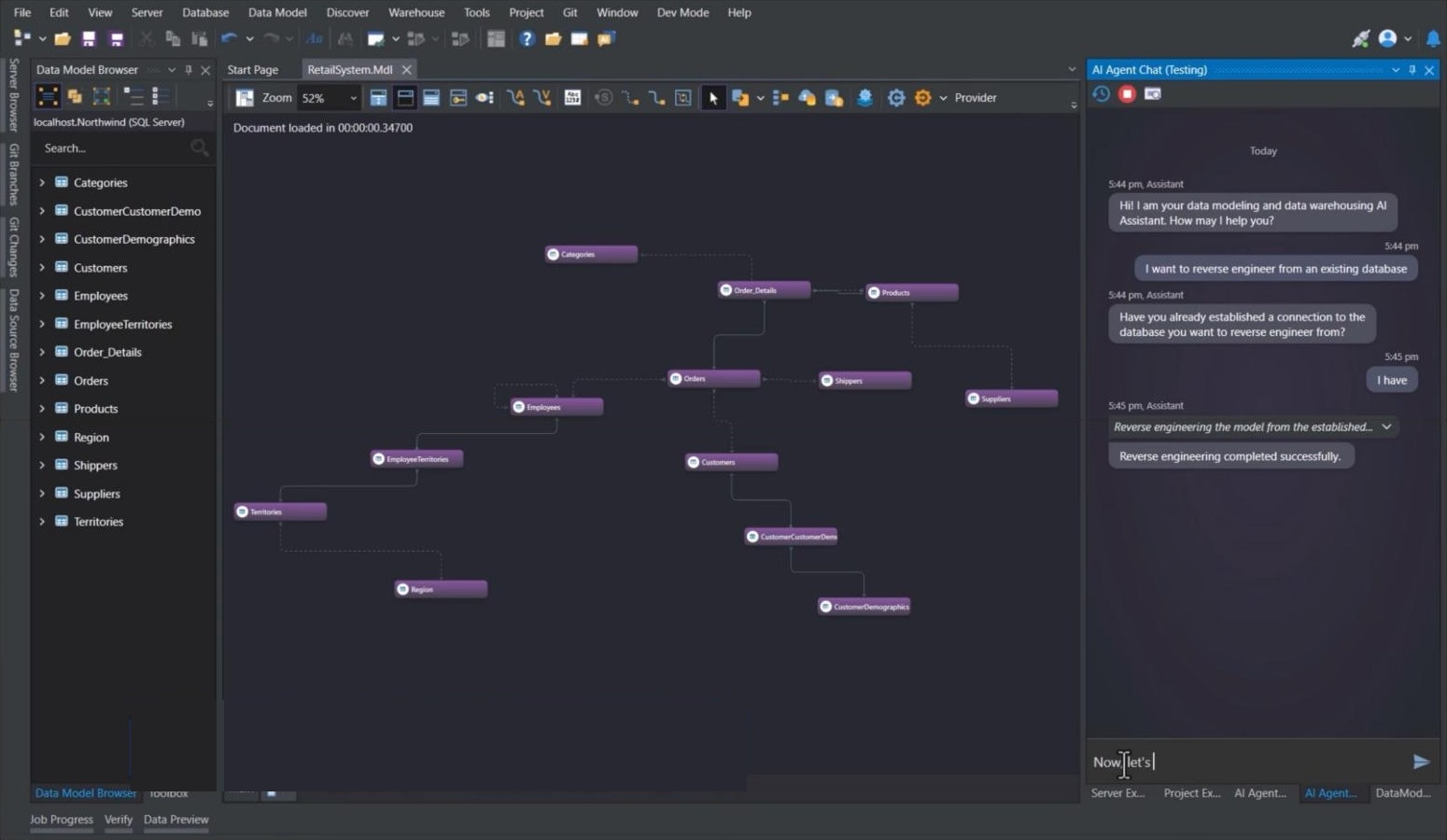
Step 1 of 5: Reverse engineer your source
See AI-powered data warehousing in action
Data warehousing capabilities in one unified platform
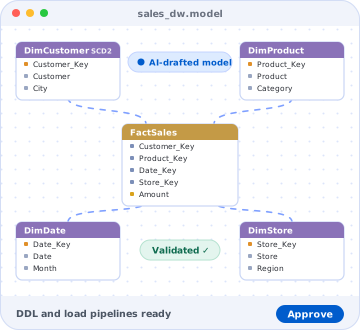
AI data modeling
Describe the warehouse in plain language or point AI at an existing database. It drafts fact and dimension tables, hierarchies and surrogate keys for you to review and approve.
Visual model builder and Auto Detect
Drag and drop to build dimensional (star or snowflake), Data Vault or OLTP models. Auto Detect classifies entities as fact or dimension from their relationships and builds date and time dimensions linked to your facts. Business users can review the visual model without reading SQL.
Reverse engineering
Extract tables, columns, relationships and constraints from a source or legacy database into a visual model, then build your dimensional design on top of it.
Slowly changing dimensions
Assign SCD types 0, 1, 2, 3 and 6 at field level, with surrogate key, effective and expiration dates, version number and current-record roles set on the model. Generated load logic handles Type 1 and Type 2 history. Placeholder dimensions handle late-arriving dimensions and early-arriving facts.
Fact and dimension loading
Pipelines are generated from the approved model: dimension loads, fact loads with surrogate key lookups, and staging layers, without hand-written SQL.
Data Vault 2.0
Model hubs, links and satellites with historization, visually, in plain language or by reverse engineering, and generate the hub, link and satellite load pipelines.
Model validation
Validation rules check your model for errors before it is forward engineered, so design issues are caught before anything reaches the warehouse.
Auto-generated DDL and forward engineering
Forward engineer the approved model with platform-specific DDL for targets such as Azure Synapse, Snowflake, Redshift, SQL Server, PostgreSQL and Oracle, and deploy one model to multiple targets.
Incremental loads with CDC
Capture changed source records only. Initial and incremental loads use the same pipeline configuration, so there is nothing to rebuild.
Transformation and data quality
Cleanse, join and aggregate data with 200+ built-in transformations before it loads. Quality rules and validation checkpoints flag failing records, with errors logged.
Pushdown and parallel processing
Push eligible processing down to the database and read sources in parallel, so loads run where your data lives.
Scheduling and monitoring
Schedule loads by time, event or file drop, and monitor pipelines, refreshes and jobs from one place, with alerts.
Analytics workbench
Ask for charts and dashboards in plain language, right on the warehouse you built. AI writes the query logic from your schema and metadata, and the engine computes the results.
Deployment and governance
Role-based access control, Git-based version control and lineage mapping across dataflows. Deploy on-premises, in your cloud or in a hybrid setup, so data stays in your environment.
Data warehousing that your team can launch and maintain
Faster path to a working warehouse
AI drafts the model and the load pipelines are generated from it, so teams move from design to a loaded warehouse faster than with hand-built schemas and per-table jobs.
Self-serve modeling
Analysts and business users design and review models visually or in plain language, so warehouse projects are not limited by SQL specialists.
Fewer handoffs, one platform
Modeling, loading, quality checks and scheduling live in one place, so a change in requirements is made once and carried through to the generated pipelines.
History handled for you
SCD roles, surrogate keys and late-arriving data are set on the model, and the generated loads apply them, so your history stays accurate.
Keep AI under your control
Agents only reach the data each user can access, your team approves every flow, and Astera never trains models on your content.
Predictable, upfront pricing
Pay a custom price that is fixed up front, with renewal terms in writing and annual increases capped for existing licenses.
Rated and recognised by the people who use it
- G24.3/531 reviews
 4.8/513 ratings
 8.7/1055 reviews

Because of Astera we have been able to evolve and manage our EDW which has data from multiple sources today
 Usability
 Performance
 Support
 Support
Pricing fixed up front, from day one.
Your price is custom and fixed up front. Renewal terms are in writing, with annual increases capped for existing licenses.
What's included
- Visual data model builder for dimensional, Data Vault and OLTP models
- AI-powered modeling and auto-mapping
- Auto-generated DDL and SCD automation
- Change Data Capture for incremental loads
- 200+ pre-built source and destination connectors
- Built-in data quality validation
- Pipeline monitoring and alerting
- Award-winning support, onboarding and training
Data warehousing FAQs
Data warehouse automation uses software to design the model, generate the schema and build the pipelines that load and maintain a data warehouse, instead of coding every table by hand. In Centerprise AI you approve an AI-drafted model and the dimension, fact and SCD load pipelines are generated from it. Learn more about data warehousing .
You describe the warehouse in plain language or point AI at an existing database. It drafts fact and dimension tables, hierarchies and surrogate keys, or Data Vault hubs, links and satellites. Your team reviews and approves the model before anything deploys. AI works at design time, and production loads run deterministic logic from the approved configuration.
Dimensional models (star and snowflake schemas), Data Vault 2.0 and OLTP models. Build them visually, describe them in plain language, or reverse engineer them from an existing schema and then add dimensional structures.
Yes. You assign SCD roles to dimension fields: insert only (SCD0), overwrite (SCD1), update and insert (SCD2) with surrogate key, effective and expiration dates, version number and current-record designator, and current and previous values (SCD3 and SCD6). Placeholder dimensions handle late-arriving dimensions and early-arriving facts.
Centerprise AI forward engineers your approved model to targets such as Azure Synapse, Snowflake, Redshift, SQL Server, PostgreSQL and Oracle, and one model can deploy to multiple targets. It also connects to Google BigQuery and Azure SQL, among 60+ native connectors and 200+ via custom API connectors.
Change Data Capture reads only the records that changed in the source, so the warehouse stays current without full reloads. Initial and incremental loads use the same pipeline configuration, so you do not rebuild anything between them.
Yes. Reverse engineering extracts tables, columns, relationships and constraints into a visual model. You can then add dimensional structures, slowly changing dimensions and denormalized designs, validate the model, and forward engineer it to your target platform.
Still have questions?
Book a demo