
The Automated, No-Code Data Stack
Learn how Astera Data Stack can simplify and streamline your enterprise’s data management.

The Role of Data Integration in Building an Effective Enterprise Data Architecture

Given the rapidly changing nature of today’s business landscape, data has become a crucial to success. However, with massive volumes of data flowing into organizations from different sources and formats, it becomes a daunting task for enterprises to manage their data. That’s what makes Enterprise Data Architecture so important since it provides a framework for managing big data in large enterprises.
In this blog, you will learn what enterprise data architecture is, its components, benefits, and challenges. We will also see in detail the role of data integration in building an EDA and how Astera’s AI-powered data stack helps organizations achieve it.
What is Enterprise Data Architecture?
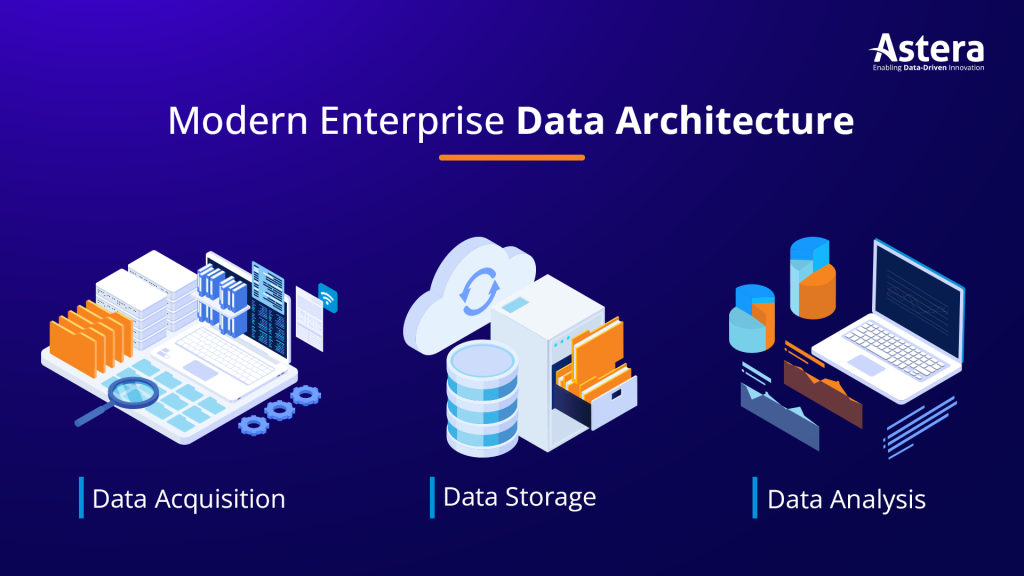
Enterprise Data Architecture (EDA) is an extensive framework that defines how enterprises should organize, integrate, and store their data assets to achieve their business goals. At an enterprise level, an effective enterprise data architecture helps in standardizing the data management processes. An EDA includes these components:
- Data Governance – comprises of a set of policies, procedures, and guidelines for managing data across enterprise.
- Data Integration – the process of collecting and combining data from multiple data sources to create a unified data view.
- Data Storage – a process of storing and managing the collected data in a data warehouse or a database repository.
- Data Analytics – a set of techniques and tools used for analysis and data interpretation to make data-driven decisions.
Benefits of Enterprise Data Architecture
An enterprise data architecture brings numerous benefits to businesses. It allows them to improve their decision making by clearly mapping their entire data architecture and aligning it to meet their business objective. An EDA offers three key benefits to businesses:
- A Solid Data Strategy: An EDA helps in defining the business’s strategies to support business rules, compliance requirements, capabilities, and IT standards.
- Efficient information flow: Provides a complete picture of the data flowing within an enterprise. It helps in identifying opportunities for improvements, as well as areas that require optimization to minimize complexity and system redundancy.
- Data Quality: EDA helps ensure that data is accurate, complete, and consistent across the enterprise. This is accomplished by applying the right data governance policies and procedures such as data integration to build a single source of truth. It makes sure that the data is captured and maintained in a standardized manner. An EDA also supports scalability by enabling enterprises to handle massive volumes of data by implementing technologies like data warehousing to enable an agile & efficient business analytics.

Challenges of Managing Data in Large Enterprises
Data architecture plays a crucial role in defining how data is managed in organizations. It has many benefits, but does not come without challenges.
Firstly, data supply chain is a challenge. Depending on the function and use of the data, it can flow across the organization and change locations. This movement of data makes the data journey complicated.
Secondly, data silos are a challenge. Traditionally data was stored in isolated departmental silos for data privacy. Data produced and used by one department was not available to other departments, limiting collaboration across enterprise. However, in today’s data driven and digital environment, organizations realize that 360-customer data is a necessity.
Hence, breaking down data silos and making the data accessible across organization is crucial. A modern enterprise data architecture is designed to breakdown these data silos by combining all enterprise data along with external data sources to create a unified view.
Third, most businesses lack an adequate infrastructure to unify data. Data moves at high speeds, high volumes, and from multiple sources, making advanced analysis a distant reality. Absence of a data integration tool coupled with data silos can leave organizations unable to drive data-driven insights.
Data cleansing is also a challenge for effective enterprise data architecture. You don’t want your data sets to contain errors & inconsistencies since they can lead to inaccurate insights and flawed decision making.
The Role of Data Integration in EDA
Data integration is the process of integrating data from disparate data sources like databases, applications, and files, into a single location. It is generally carried out by following an ETL process which comprises of three main steps: data extraction from various sources, data transformation, and loading data into the desired destination.
Data integration is an integral part of the overall enterprise data architecture. It enables enterprises to bring all their data together to create a centralized data repository. Data stored in a centralized location provides a unified data view across enterprises, making to more accessible and analysis ready.
For an effective EDA, it’s crucial to integrate your data stored across multiple systems, applications, cloud platforms, and departments into a unified view. The more quickly data is integrated, the faster you can extract powerful insights. It allows your organization to improve inter-departmental collaboration and helps you better understand the customers. Moreover, by eliminating data silos and redundant data storage, organizations can also reduce data management costs.
On the contrary, if an enterprise does not have an efficient integration process in place, it can have undesirable consequences. It may lead to inaccuracies, duplication, inconsistencies, and errors which in turn lead to flawed business decisions and a corrupted data architecture.
Related: Learn more about data integration with this guide.
Build Your Enterprise Data Architecture With Astera
Astera’s unified data management platform provides you with the tools to construct and manage your enterprise data architecture. It facilitates the consolidation of data from varied sources into a central repository, transforming raw data into actionable insights suitable for analytics and reporting.
The platform is designed for ease of use, offering a 100% no-code environment for many of its functions. This approach simplifies tasks such as creating and managing data pipelines and data warehouses, automating workflows, and connecting diverse data sources, whether they are on-premises, in the cloud, or in hybrid environments. Astera supports both ETL (Extract, Transform, Load) and ELT (Extract, Load, Transform) approaches, offering flexibility in how you process and integrate data.
Key capabilities that support the development of a robust data architecture:
Automated data integration and transformation: Use Astera Data Pipeline to integrate data from numerous enterprise applications, databases, and cloud services. You can create a holistic view of your organization’s data assets by extracting, cleaning, transforming, and validating data, even from unstructured sources.
Data warehouse automation: Streamline the creation of your data warehouses with Astera Data Warehouse Builder. It supports various industry-standard modeling techniques such as Third Normal Form (3NF), Dimensional Modeling, and Data Vault Modeling and facilitates the transformation of logical data models into physical models across different platforms like Snowflake, Redshift, and PostgreSQL.
API and EDI management: Quickly design, test, and deploy APIs. With Astera you can integrate applications, systems, and data and build new products and services that
meet your customers’ evolving needs. With EDI capabilities, Astera also enables you to establish connectivity with your business partners from various industry groups across the cloud or via internal systems.
Download a 14-day free trial or sign up for a demo to learn more.
Authors:
Astera Marketing Team